Auto Demo
Slide Source: 1
CIOB CIOB

Fire Safety Principles in Buildings

A Practical Introduction · V2

2026 Edition · V2 · 8 Modules · 60–90 min self-paced

Learning Objectives

  • Explain why buildings are engineered as life-safety systems, not passive enclosures.
  • Describe the Fire Triangle and how heat, fuel, and oxygen interact to produce and sustain fire.
  • Apply the seven core fire-safety principles to any building type.
  • Compare ASET (Available Safe Egress Time) against RSET (Required Safe Egress Time) and explain how each is influenced by building features and human response.
  • Differentiate passive and active fire-protection systems and evaluate how they combine to buy time and protect escape routes.
  • Identify common real-world failures (workmanship defects, compartmentation gaps, external-wall risks) and explain how to mitigate them.
v1.0 — Press Enter or click to begin

About This Course

Fire Safety Principles in Buildings · A Practical Introduction · V2 · 2026 Edition

Overview

Fire safety in buildings is one of the most important responsibilities for everyone involved in the design, construction, occupation, and management of the built environment. A modern building is not simply an enclosure — it is a life-safety system, engineered to protect the people inside it during the most demanding emergency a structure can face.

This short, practical course introduces the core principles that govern fire safety in buildings. It is designed for designers, engineers, project managers, facilities professionals, and anyone whose work touches the built environment, regardless of prior fire-safety experience.

The aim is not to make you a fire engineer, but to give you the conceptual fluency to recognise how buildings are intended to behave under fire, how the core principles interact, why time is the central currency of safe escape, and where real-world failures most commonly occur.

Key Course Themes

Fire safety as a system, not a single solution.
The importance of time in safe evacuation.
The interaction between design, use, and management.
The consequences of poor workmanship and maintenance.

Course Format

  • Self-paced learning, designed to fit your schedule.
  • Structure: modules covering principles, time and escape, protection systems, and real-world application.
  • Delivery: interactive web-based learning with diagrams, animations, scenarios, and knowledge checks.

Learning Methodology

  • Visuals and animations that make abstract principles tangible.
  • Real-world scenarios drawn from contemporary practice and known incidents.
  • Interactive components that surface design decisions and their consequences.
  • Knowledge checks at module boundaries plus a final assessment.

Suitability

Designers, architects, engineers, construction project managers, facilities and building managers. No prior fire-safety knowledge is needed — the course builds from first principles.

Assessment

Module-level knowledge checks reinforce key ideas as you progress. A final assessment at the end of the course confirms understanding across all modules. Achieving a passing grade allows you to complete the course.

Supporting Materials

  • Annotated diagrams of building systems and fire-protection components.
  • Good-vs-poor practice comparisons drawn from real construction details.
  • Scenario examples illustrating design, use, and management interactions.
  • Embedded video and motion content where it supports the learning point.

About the Author

Developed by a Building Control Consultant with experience across fire-safety strategy review, regulatory compliance, risk identification, and design review for a wide range of building types.

Course Contents

8 modules · several pages · self-paced

M0Introduction: Buildings as Safety Systemsseveral pages
01 Reading
Introduction — Fire Safety Principles
Intro Poll — Key Considerations
03 Hover
A Building is a Safety System
M1Fundamentals of Fireseveral pages
The Fire Triangle
05 Slider
Construction vs In-Use
M2Core Fire Safety Principlesseveral pages
06 Principle 1
Fire Prevention
07 Step-Through
Detection & Warning Sequence
08 Cutaway
Containment
09 Corridor
Smoke Control
10 Interactive
Means of Escape
Inclusive Evacuation
12 Explorer
Firefighting Access
Core Principles Knowledge Check
M3Time and Escape (ASET vs RSET)several pages
ASET vs RSET
15 Animation
What ASET Means
What ASET Includes
17 Animation
What RSET Means
18 Drag & Drop
What RSET Includes
ASET > RSET Rule
ASET vs RSET Summary
21 Explorer
Building & ASET
22 Explorer
What Parts Affect RSET?
M4Real-World Application and Common Failuresseveral pages
23 Selector
Applying ASET/RSET to Real Buildings
24 Toggle
Scenario 1: Home ASET
25 Hotspots
Scenario 1: Home RSET
26 Toggle
Scenario 2: Office ASET
27 Slider
Scenario 2: Office RSET
28 Toggle
Scenario 3: Hospital ASET
29 Drag & Drop
Scenario 3: Hospital RSET
ASET vs RSET Summary
M5Passive and Active Fire Protectionseveral pages
31 Toggle
Passive vs Active: Sports Team Analogy
What Each Element Achieves
33 Explorer
Passive = Built-in Protection
34 Toggle
Compartmentation: Lunchbox Analogy
35 Hotspots
Fire Doors
36 Interactive
Fire Stopping / Cavity Barriers
37 Simulation
Active = Built-in Warning + Suppression
38 Animation
Detection + Alert
39 Interactive
Suppression / Sprinklers
40 Toggle
Smoke Control + Emergency Lighting
Passive/Active Summary
42 Quiz
Passive/Active Knowledge Check
43 Hotspots
External Fire Spread
M6Summary and Final Assessmentseveral pages
Triangle + Time + Features = Safety
Importance of Workmanship
Final Assessment

Introduction -- Fire Safety Principles

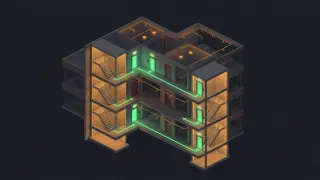
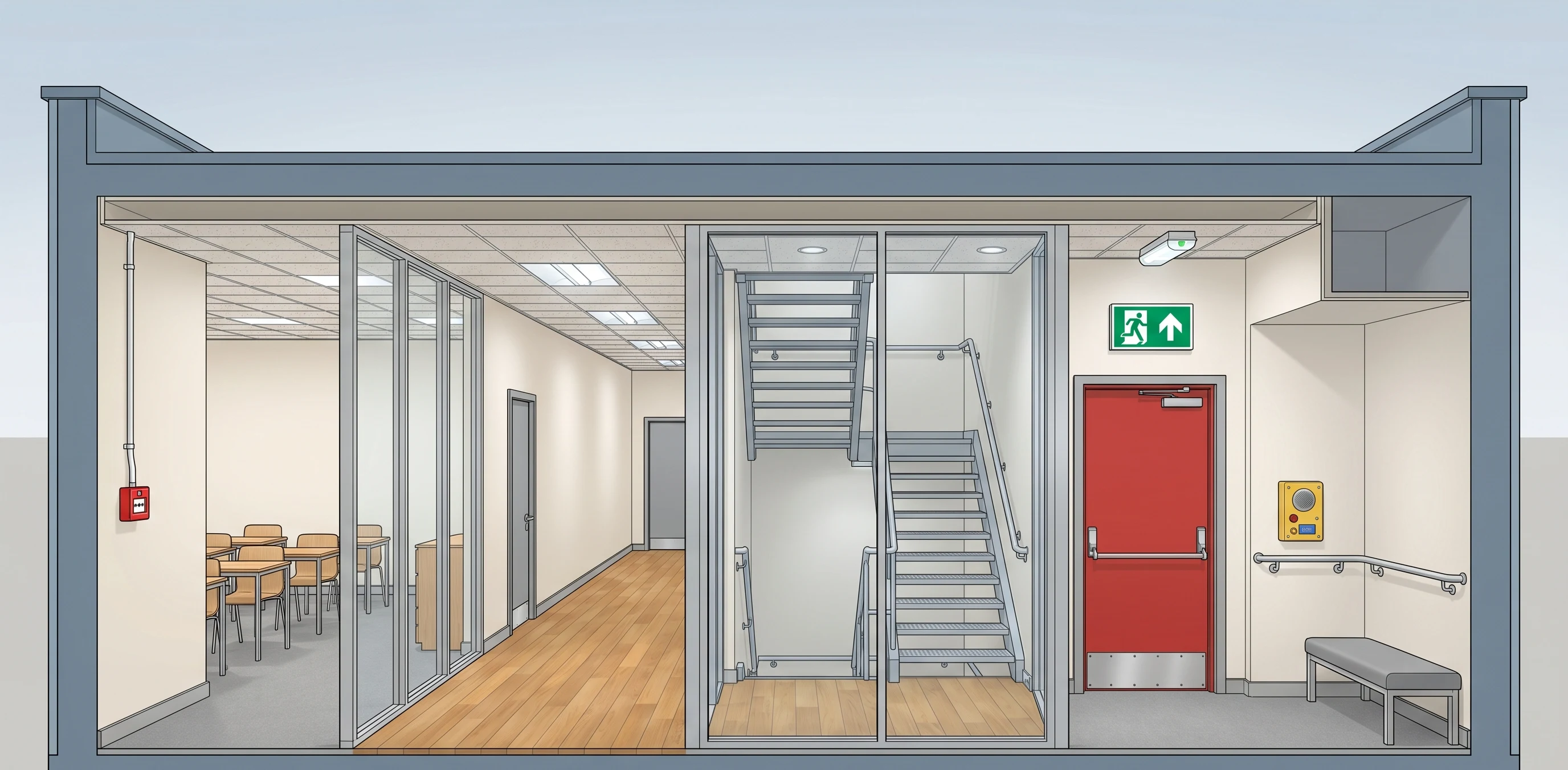
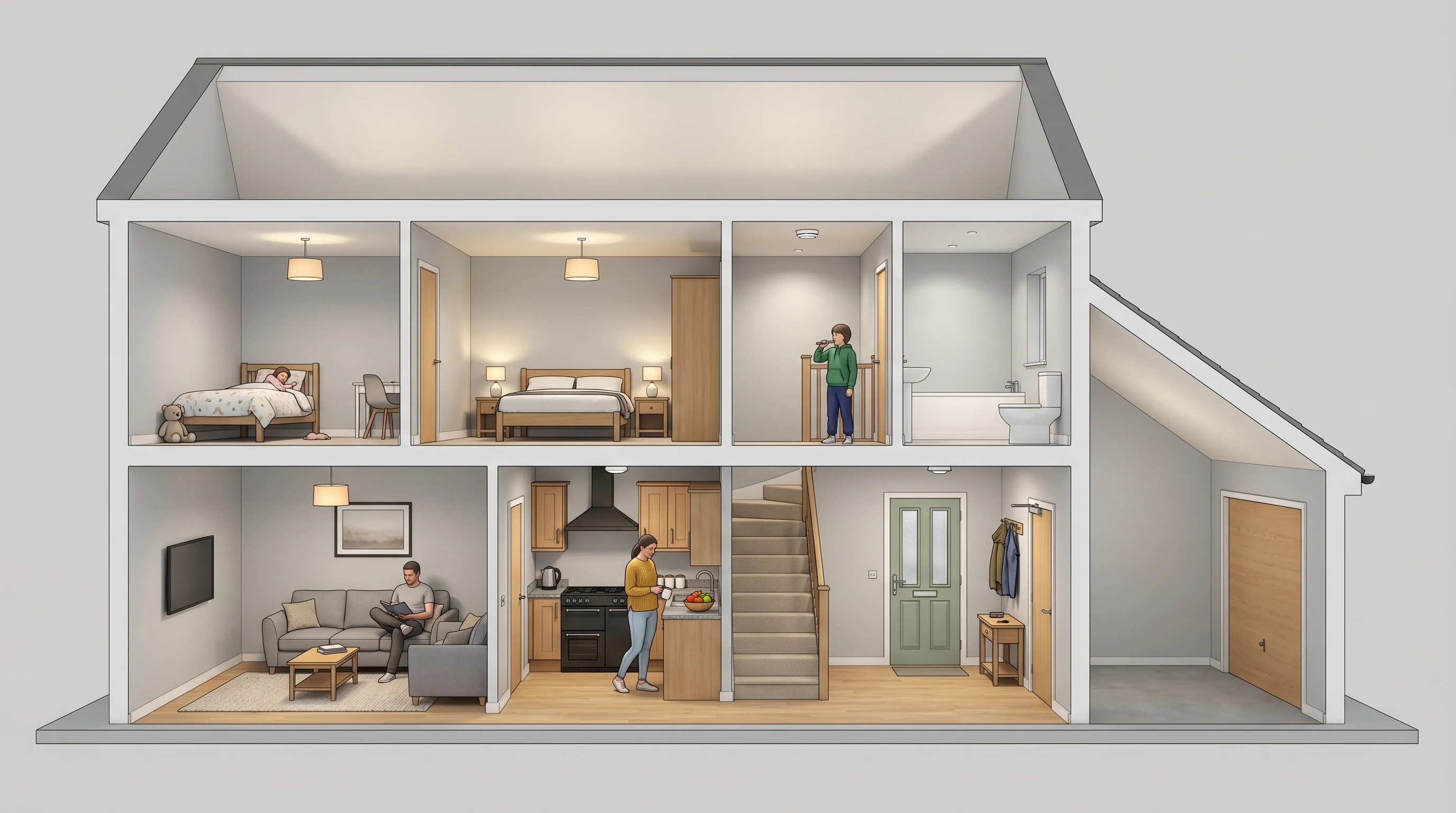
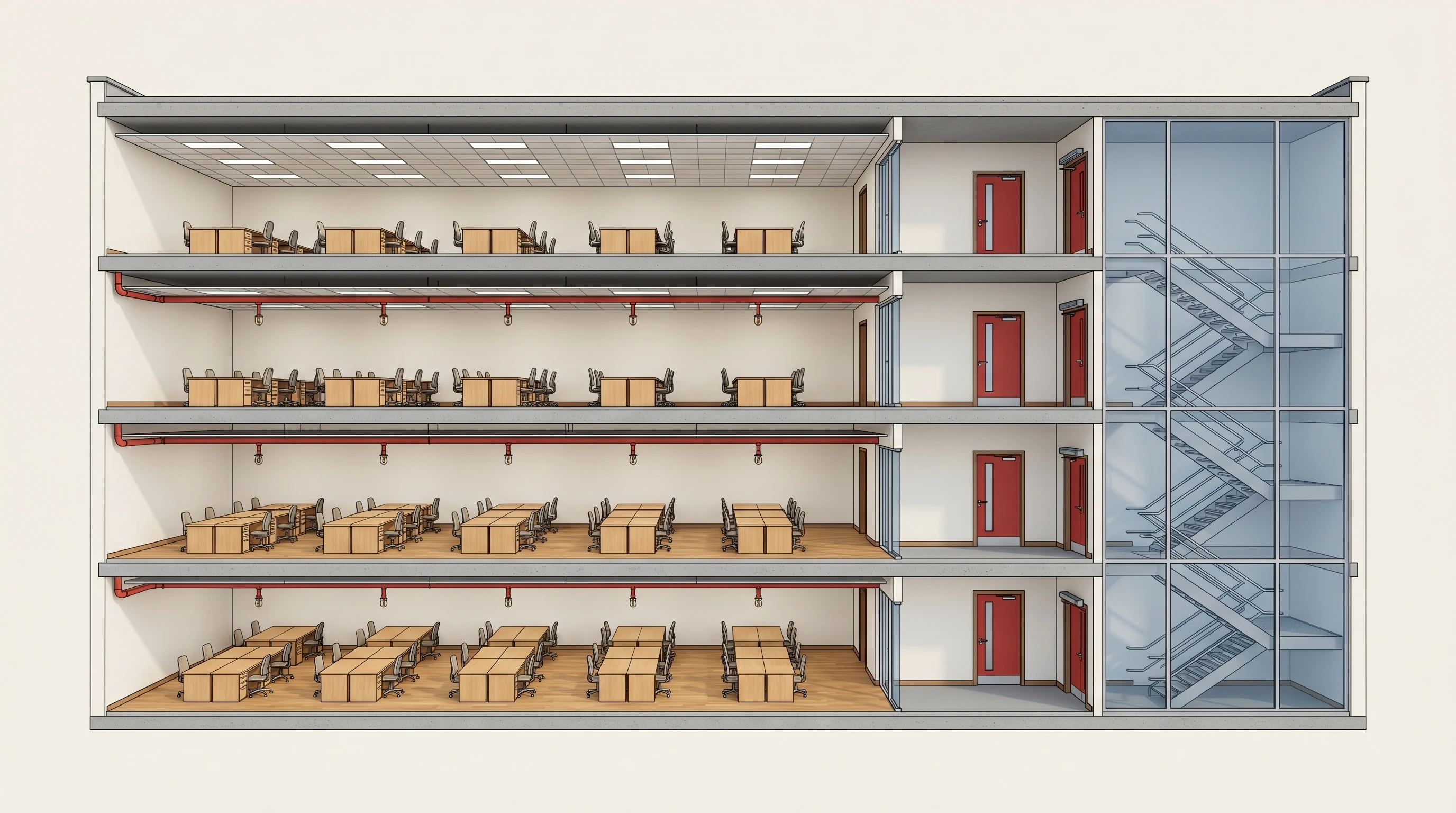
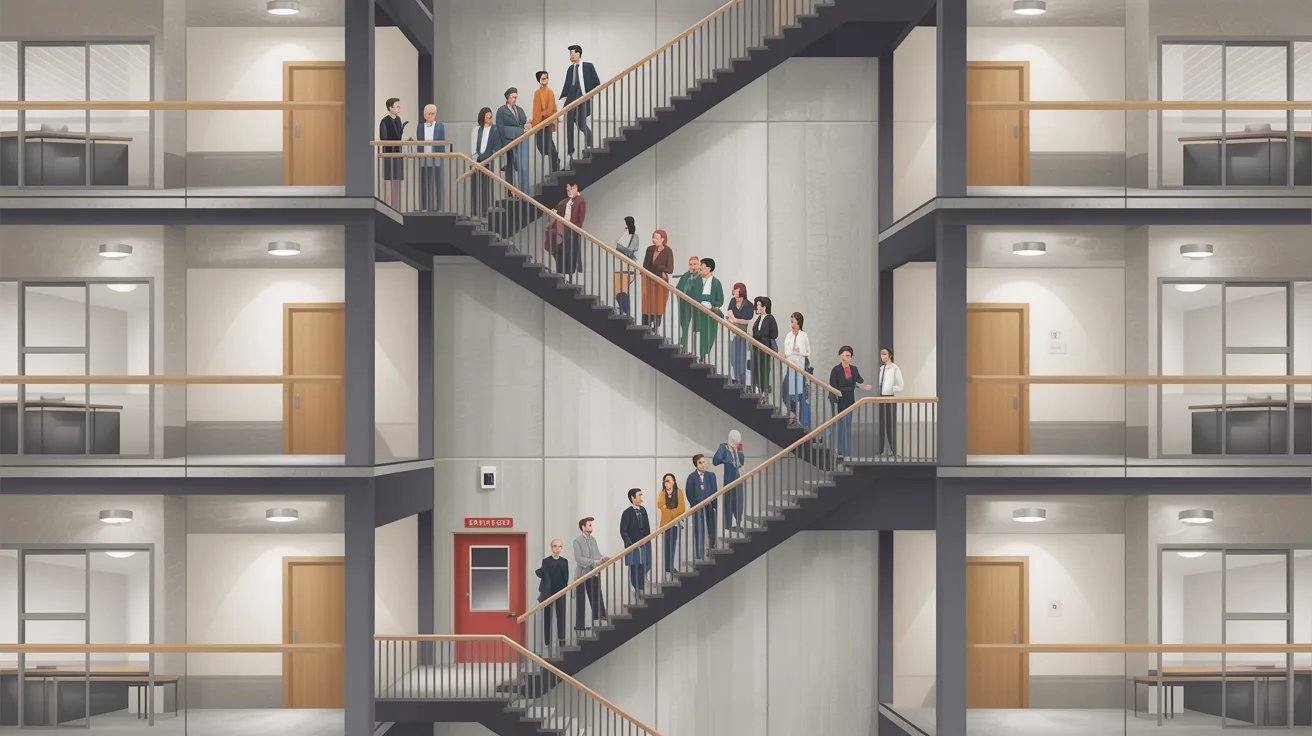
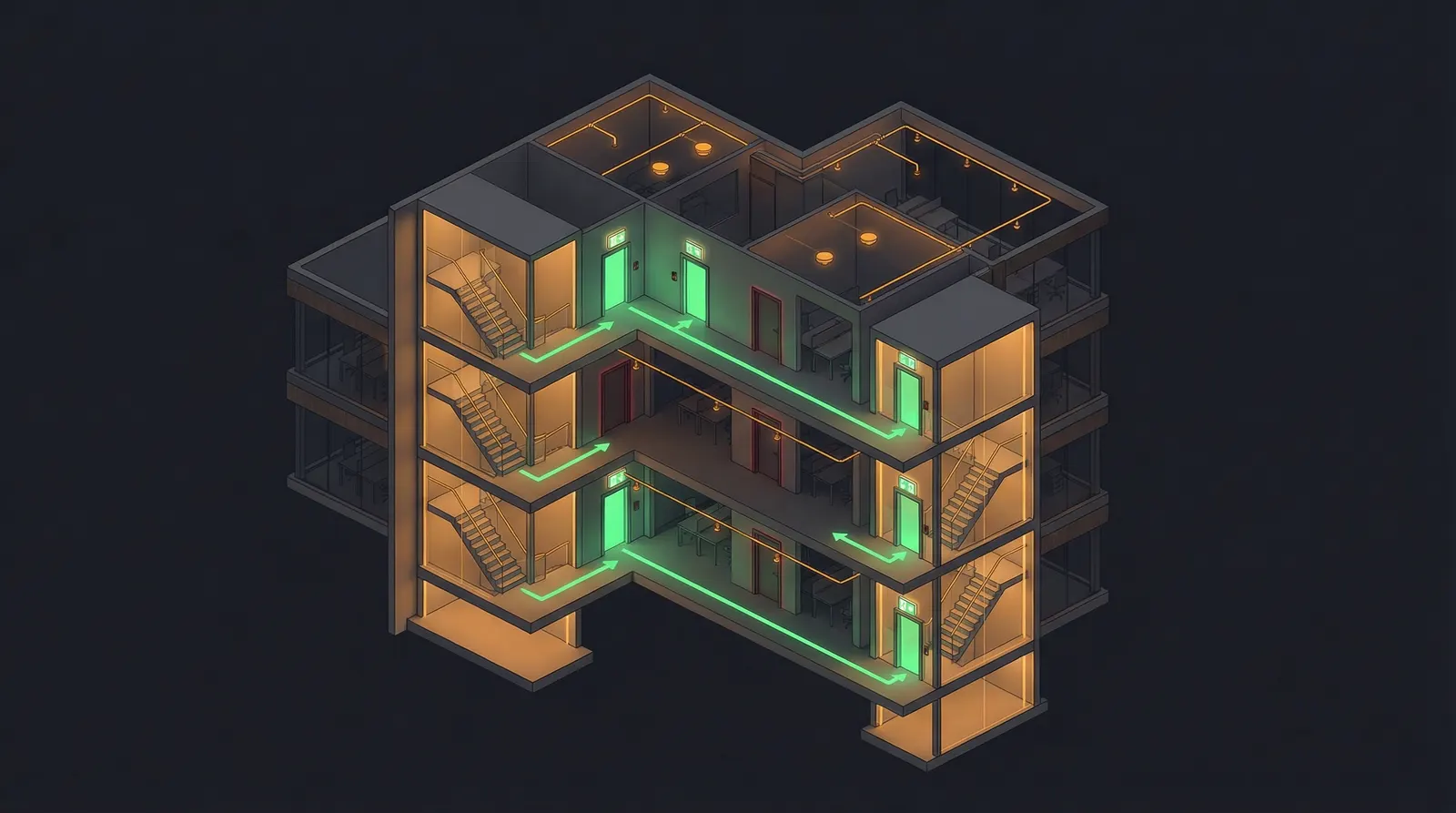
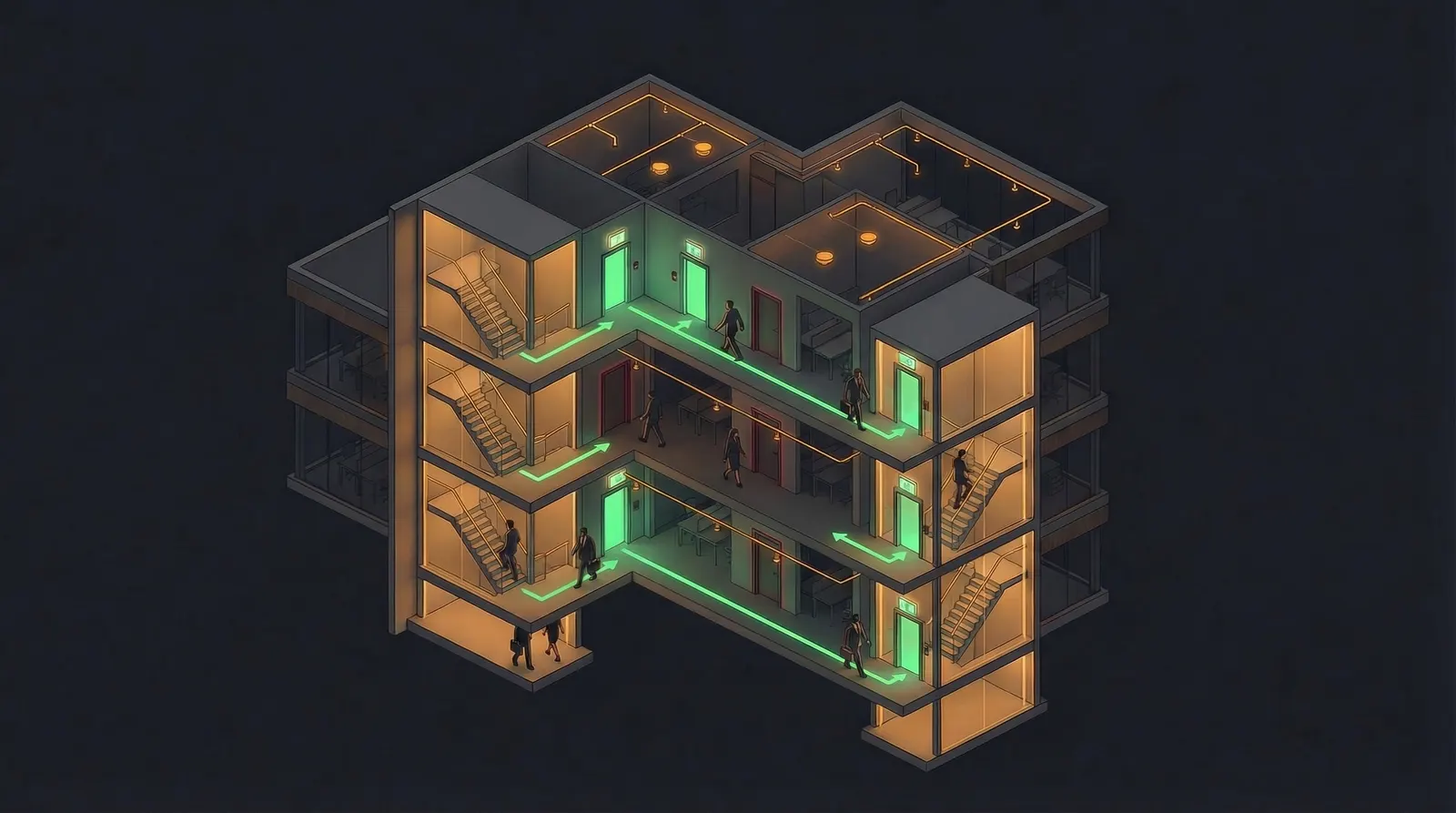
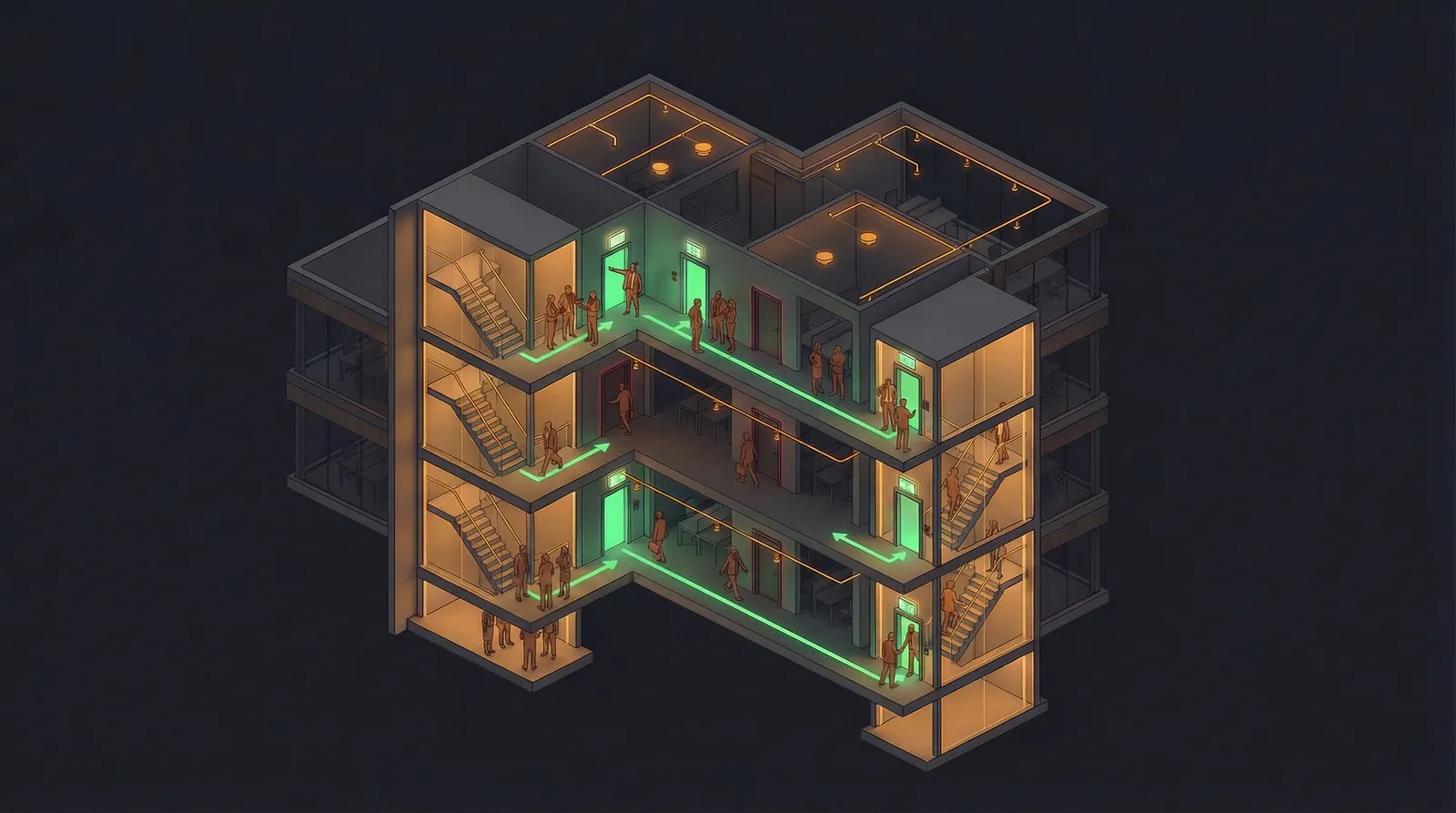
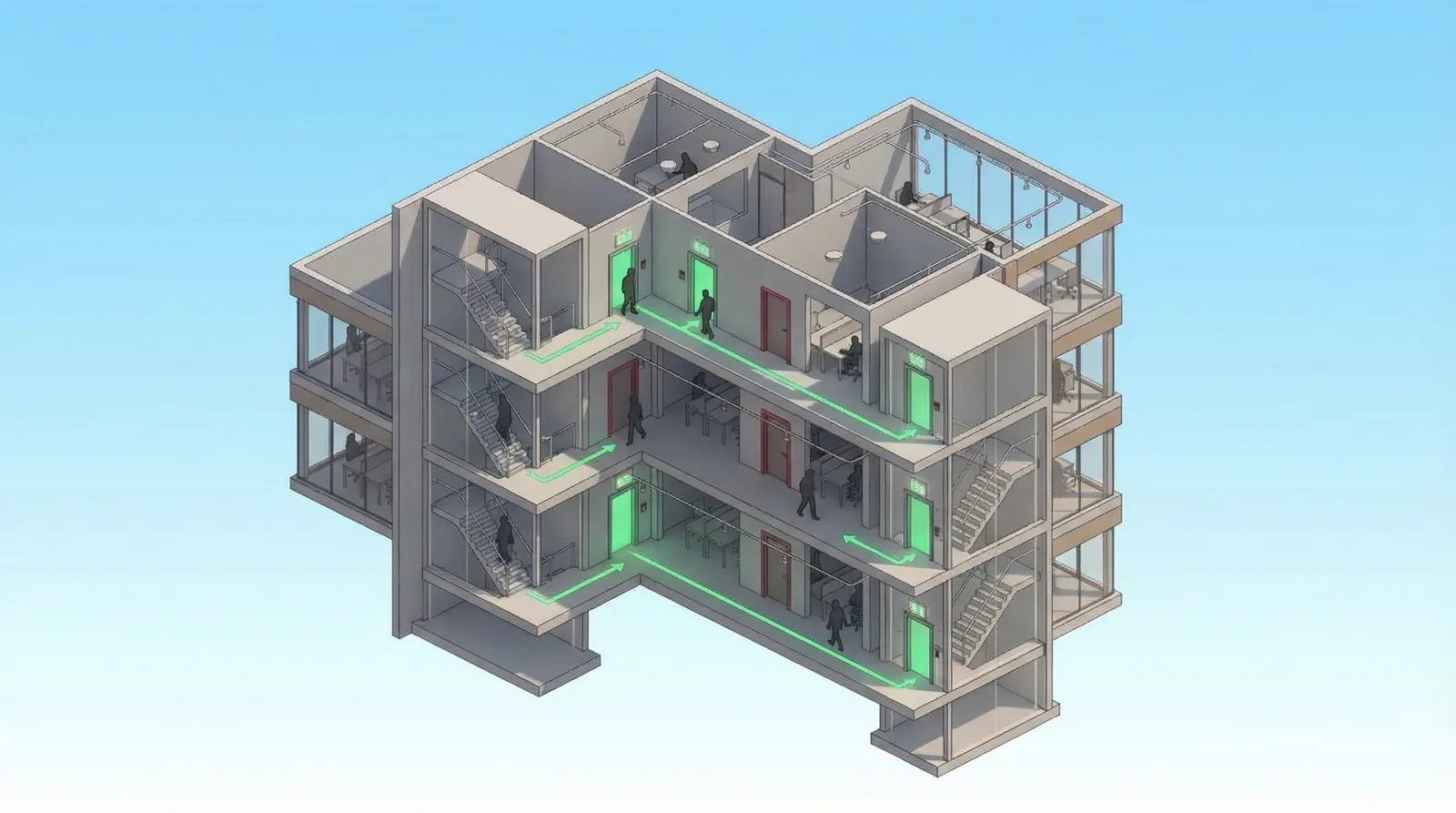
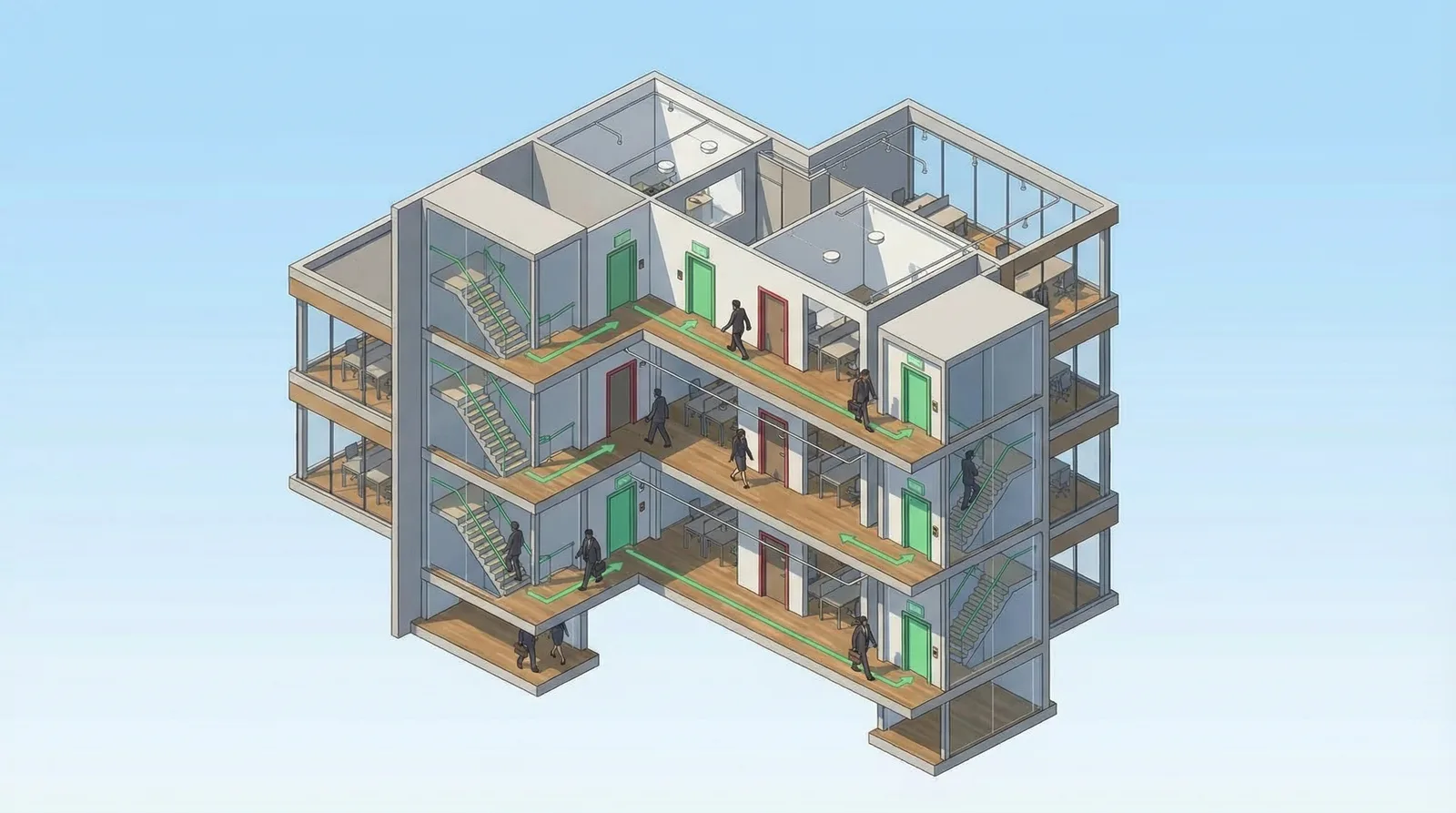
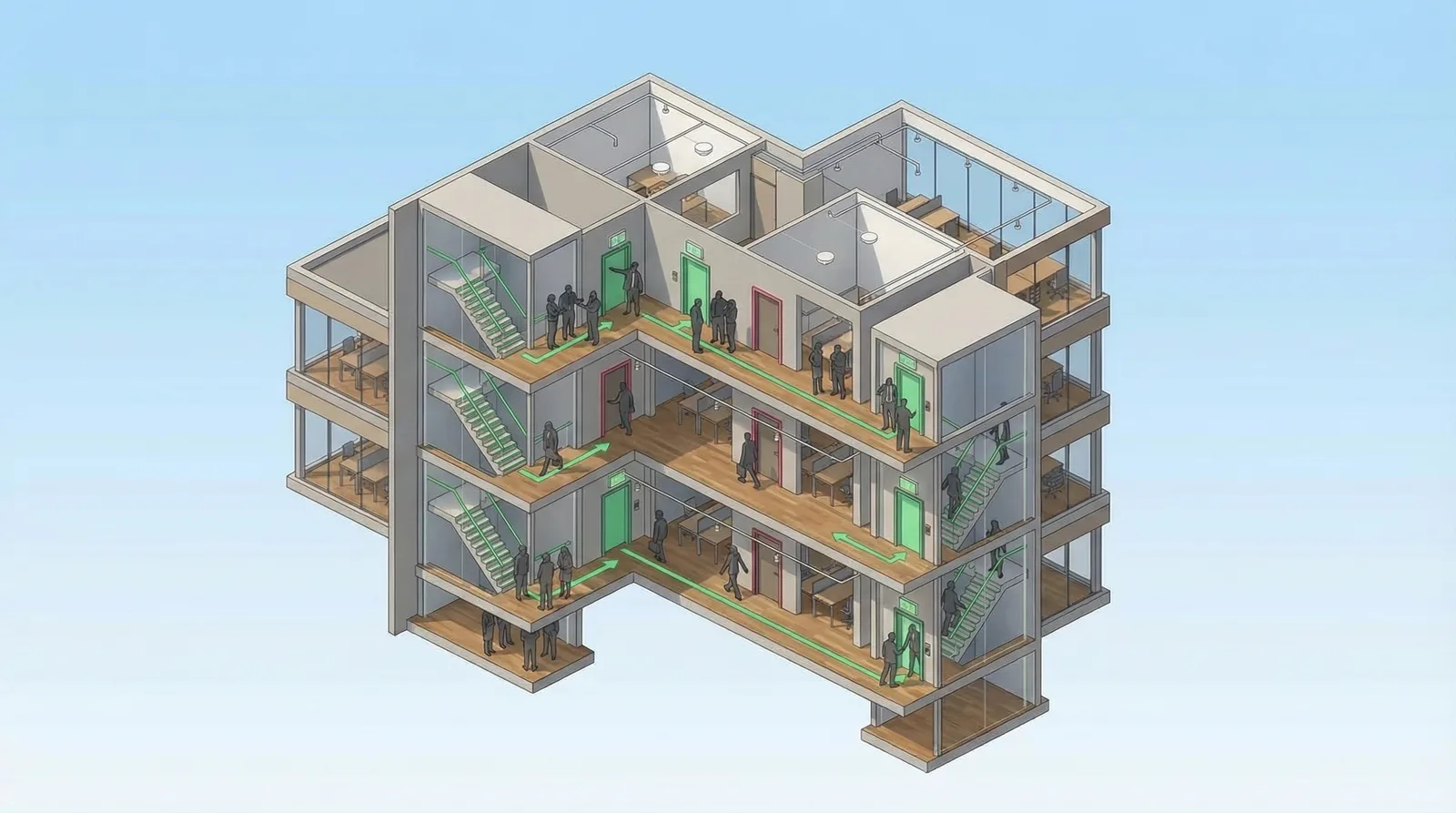
Building cross-section with fire safety features, empty (dark mode) Building cross-section with workers walking calmly through (dark mode) Building cross-section with workers distributed across multiple floors (dark mode) Building cross-section with fire safety features, empty (day) Building cross-section with workers walking calmly through (day) Building cross-section with workers distributed across multiple floors (day)

Fire safety principles exist for one purpose: keeping people safe. Every regulation, every design requirement, and every inspection protocol traces back to this single objective.

Life safety principles focus on protecting people -- not property, not aesthetics, not cost efficiency. When there is a conflict between safety and any other consideration, safety wins. Always.

Buildings are complex safety systems. A single building might contain dozens of interconnected fire safety measures -- from the structural fire resistance of its frame, to the detection systems on its ceilings, to the training of its occupants. Each measure is a layer of protection.
In the following modules, you will explore these layers interactively: how they work individually, how they connect, and why each one matters. You will build the fire triangle, step through the detection and warning sequence, and examine how containment and smoke control protect escape routes.

This is not abstract theory. These are the principles that determine whether people survive a building fire.

Slide Source: 2

Fire safety standards = a plan for keeping occupants safe

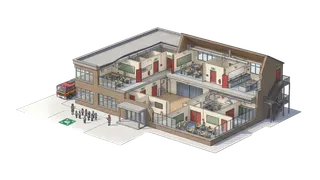
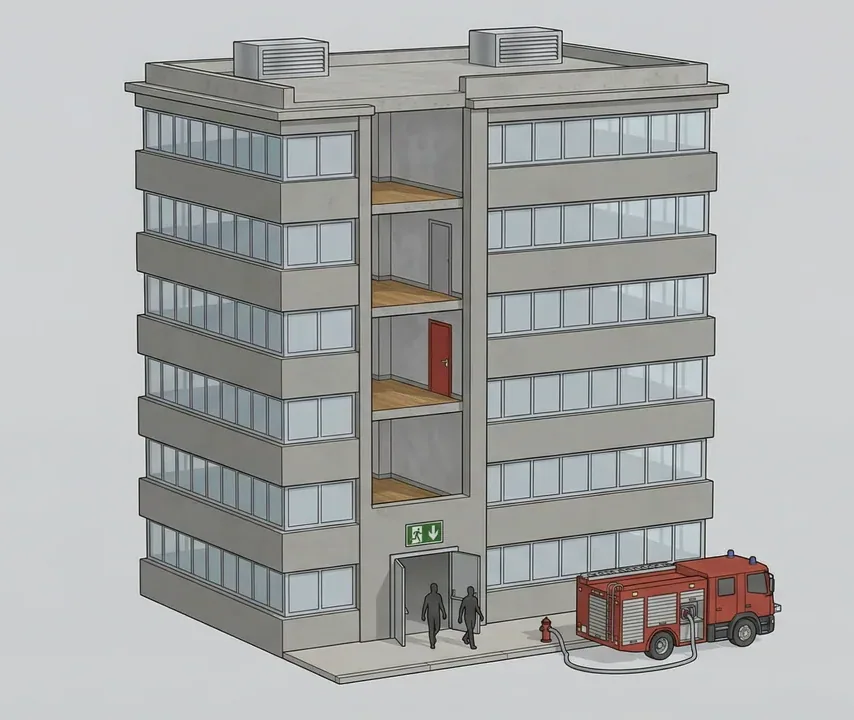
Cutaway view of a commercial building showing escape routes, fire doors, compartmentation, rooftop smoke vents, and a fire service engine at the kerb -- a visual summary of the holistic fire-safety system

Buildings are designed and managed so that if a fire starts, people can get out safely and the fire can be controlled.

Designs will also consider firefighters attending an emergency.

Life safety standards do not consider property protection.

0 of 10 selected

Slide Source: 3

A Building is a Safety System

0 of 0 explored

The layered approach

Building safety systems are designed as a layered approach. Each layer below adds a dimension of protection, and it is the combination of layers -- not any one of them alone -- that keeps people safe.

  1. People — familiarity with the building, occupant type (care facility, hospital, school, office)
  2. Building features — detection systems, fire suppression, compartmentation zones
  3. Use — risk introduced through how the building is actually used (factory, home office)
  4. Management — maintenance regimes, training, fire risk assessments
  5. Emergency response — fire service access and on-site procedures
Reframe fire safety as a system, not just one feature such as an alarm. Every layer above adds protection; no single control is enough on its own. This is how experienced assessors look at a building -- never as a single element, always as a set of interacting layers.

Hover each zone on the building above to see examples and the impact each layer can have.

Slide Source: 4

Learning outcome
0 of 3 explored

Slide Source: 5

Construction vs In-Use

Drag the slider to see how a building designed safely can become unsafe when occupant behaviour degrades its fire safety features.

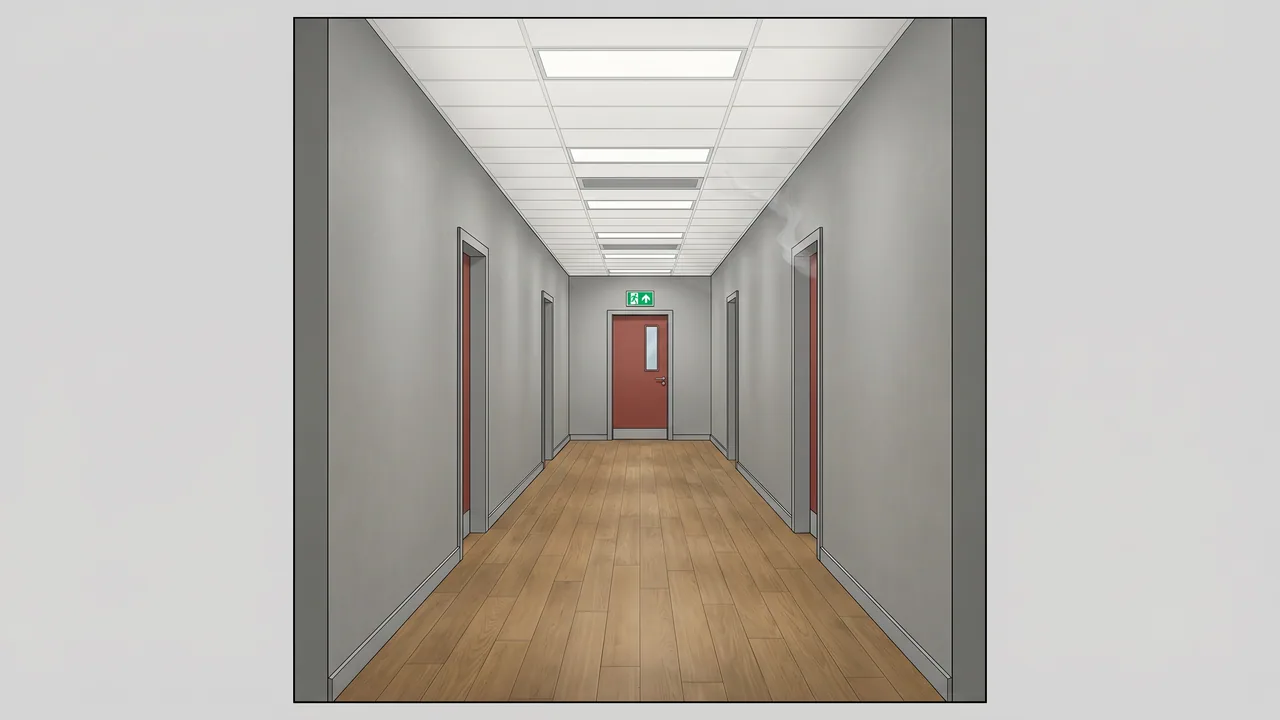
Newly built UK office corridor in semi-realistic technical illustration style, identical camera and geometry to the daily-use reference: red-painted FD30S fire doors with warm timber frames and blue FD30S plugs, BOTH side-wall doors CLOSED flush with the wall, international safety-sign guidance green running-figure exit sign above the final exit door at the far end, even 5500K LED ceiling troffers, clean empty corridor, no extinguisher, no boxes, no chairs, no coats, no wedges -- pristine post-handover state Same UK office corridor in daily use: identical camera, walls, floor, ceiling and door positions to the as-built reference. Left-wall FD30S door propped open INTO the side room by a red BS EN 3 portable fire extinguisher standing upright on the floor inside the room against the door leaf (signal-red cylindrical body, black top cap) -- a clear misuse of safety equipment. Right-wall FD30S door closed flush. No wedges anywhere. Cardboard boxes, folded stacking chairs and an amber hi-vis coat against the left wall obstructing escape width, one ceiling troffer dimmed, international safety-sign guidance exit sign still lit -- only the in-use state has changed
As Built In Daily Use

As Built

What designers assume on day one
  • Fire doors closed, self-closing, and effective at containing fire
  • Escape routes clear, unobstructed, and well signed
  • Detectors, alarms, and sprinklers fully operational
  • Emergency lighting visible and maintained

In Daily Use

How behaviour erodes the system
  • Fire doors wedged or propped open for convenience
  • Corridors used as temporary storage
  • Detectors covered, sprinkler heads blocked
  • Maintenance and training slip over time

Key takeaway: A building can be designed safely and still become unsafe when it is not used correctly. Designers assume behaviour -- they can influence it, but they cannot control it.

Slide Source: 6

Fire Prevention — Stop the spark. Control the fire.

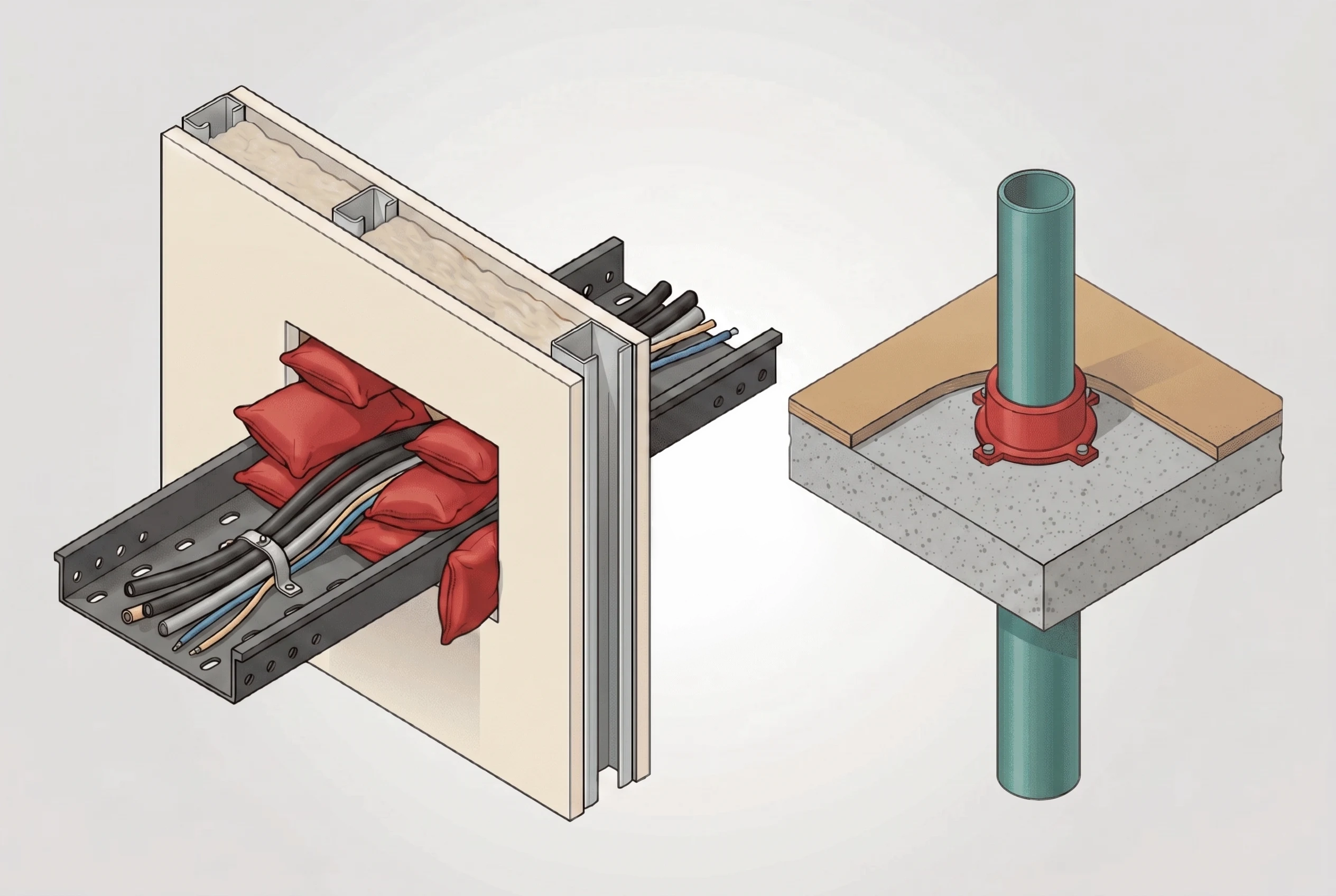
Isometric architectural cutaway, two correct fire-stopping applications side by side. Left: horizontal cable trunking passing through a fire-rated stud partition wall, with the wall opening around the trunking completely packed with stacked red intumescent pillow packs in a brick pattern, cutaway reveals mineral wool insulation inside the stud cavity. Right: a vertical plastic plumbing pipe passing through a concrete floor slab, with a red cylindrical intumescent pipe collar bolted to the slab around the pipe at slab level. Fire-safety red is used only for the pillow packs and the pipe collar; neutral architectural palette elsewhere.

Purpose — stop the spark, and control the fire.

No control over ongoing use, but control over materials used in construction. Designers look for construction elements that contain the fire based on height and use (risk).

Fire triangle link — fire prevention removes heat and fuel at the design stage by specifying non-combustible materials and installing barriers (cavity barriers, fire stopping) that keep accidental ignition away from combustible elements.
Slide Source: 7

Detection & Warning Sequence

Stage 0 of 4
Before ignition: UK open-plan office floor in normal everyday state. Extension lead plugged into wall socket beneath a desk, cables tidy, no fire, no smoke, air clear. Closed red FD30S meeting-room door on the left, closed red stairwell fire door at the far end with international safety-sign guidance exit pictogram above, ceiling smoke detector idle, wall-mounted sounder-beacon silent. Click Ignition to begin the detection sequence.

Slide Source: 8

Containment

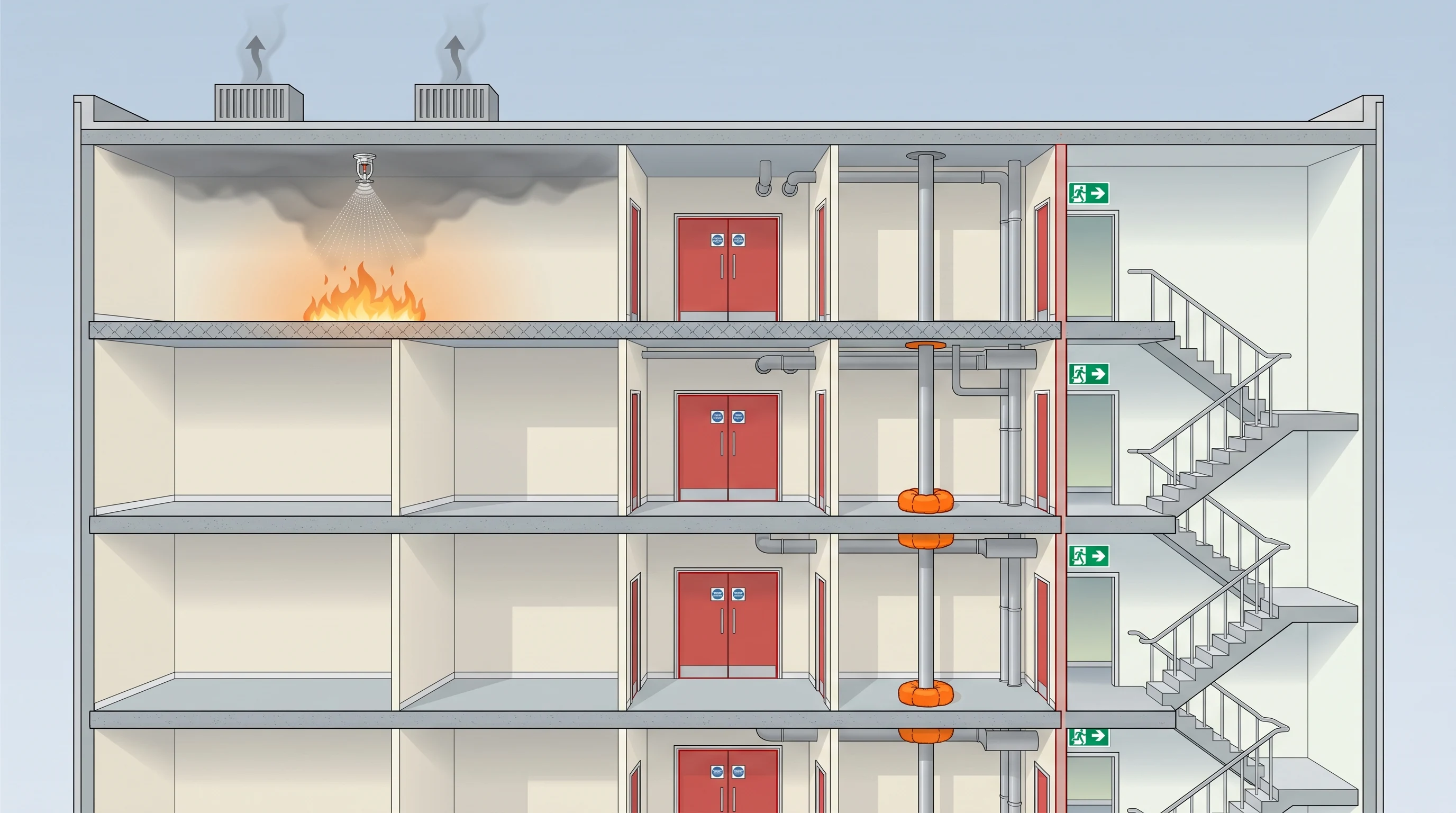
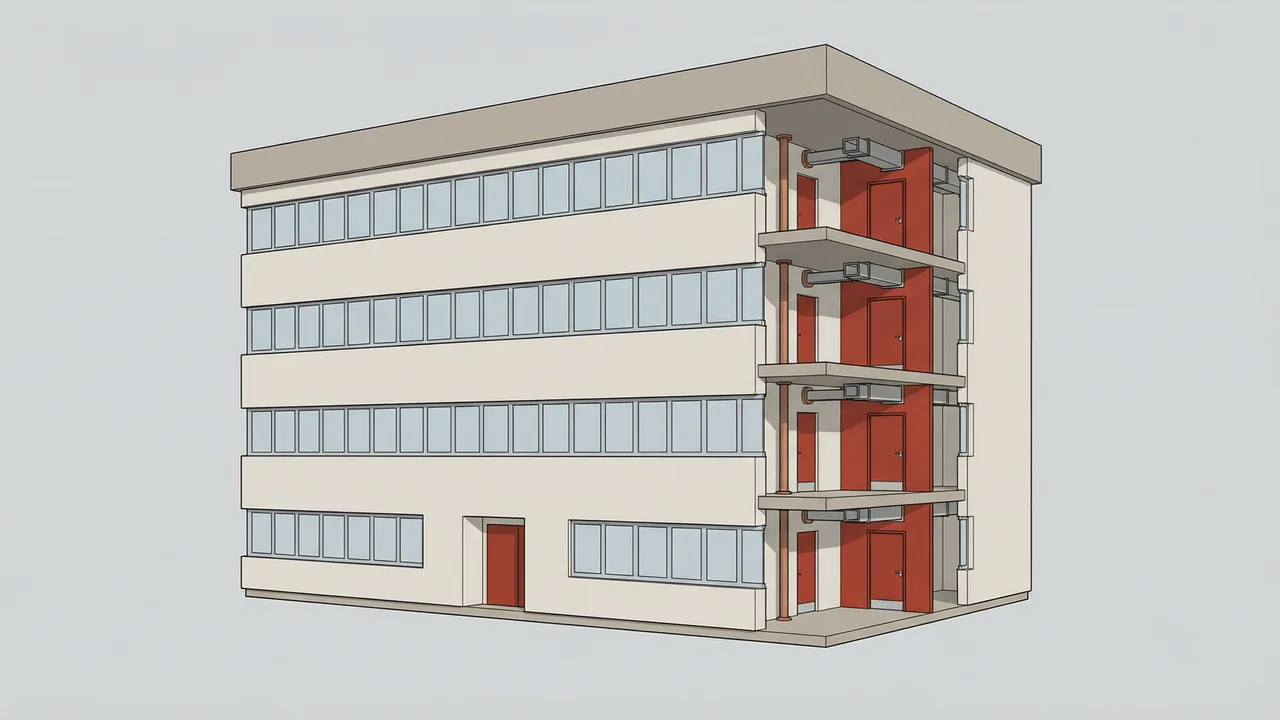
Fire containment is the principle of limiting fire spread through compartmentation -- dividing the building into fire-resistant zones. Walls, floors, doors, and barriers work together to keep a fire trapped in its zone of origin, buying time for evacuation and firefighting.

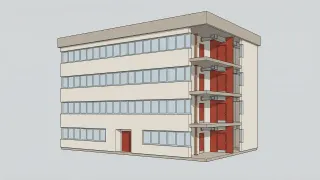
Step 1: intact four-storey building exterior
Grab the slider and drag to explore each element

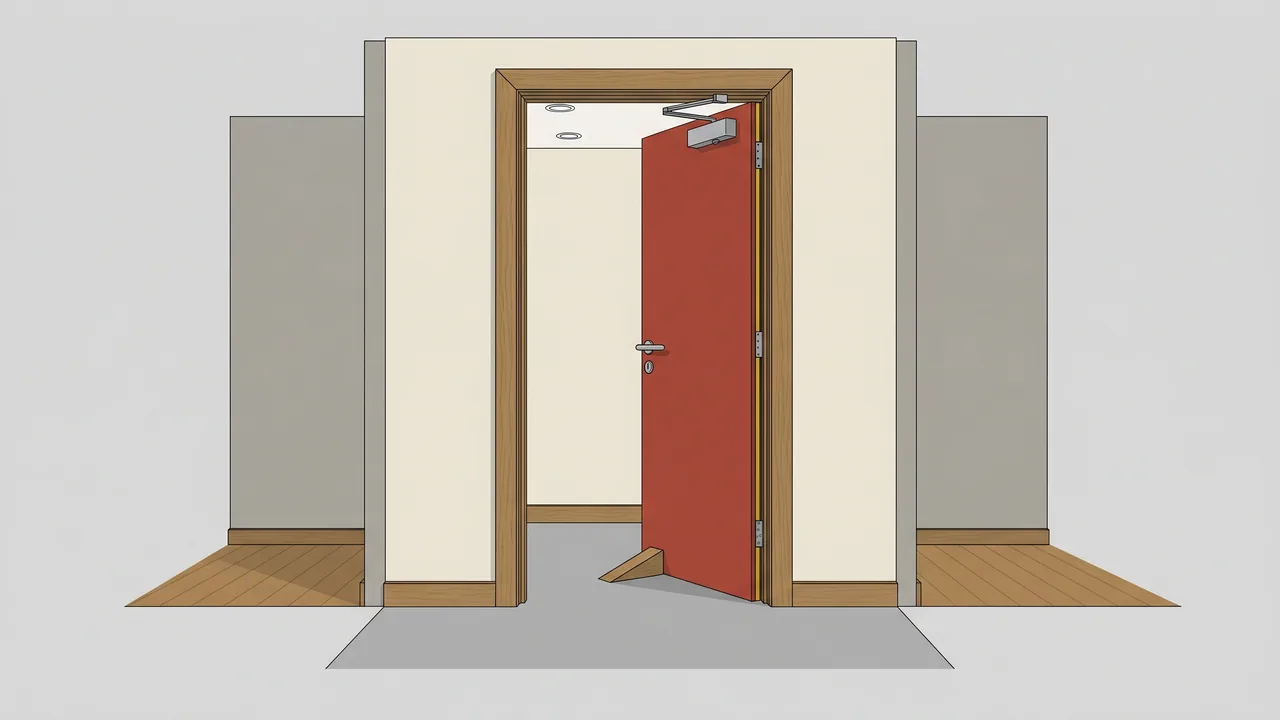
Element failure. When a containment element fails (for example a fire door wedged open), fire and smoke spread from one compartment into the next and can cut off means of escape.

Slide Source: 9

Smoke Control

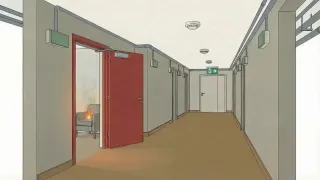
Smoke is the primary killer in building fires. Smoke control systems manage the movement of smoke through a building, maintaining tenable conditions along escape routes long enough for occupants to evacuate safely.

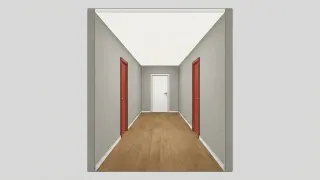
Stage 1: clear escape corridor with no smoke
Grab the slider and drag to fill the corridor with smoke

Slide Source: 10

Means of Escape — See the Difference

Purpose — Demonstrate the risk of smoke and the importance of properly managed escape routes. Smoke control may not be considered in dwellings, but it is critical in commercial environments and common areas.

Poorly Managed
Dark confusing corridor with no lighting, no signage, obstructed path
    Properly Managed
    Properly lit corridor with emergency lighting, exit signs, clear path

      Escape Route Checklist

        Fire triangle link — Means of escape focuses on life safety -- reducing human exposure to fire and smoke. It does not prevent the fire itself, but ensures people can get out before conditions become untenable.
        Slide Source: 11

        Inclusive Evacuation — Protecting Everyone

        Fire safety standards protect everyone, not just the able-bodied. Match each person to the evacuation strategies that suit their needs.

        Fire triangle link — Life safety focuses on reducing risk to people, not preventing the fire itself. Different populations need different strategies.
        Slide Source: 12

        Firefighting Access & Facilities

        Explore the multi-storey building from the fire tender at ground level to the fire floor. Click each zone to see what the fire service needs.

        Multi-storey building with labeled firefighting access zones
        0 of 6 zones explored
        Fire triangle link — Firefighting removes heat (cooling with water) and prevents spread of more fuel. Access and water supply support effective firefighting.
        Slide Source: 13

        Core Principles Knowledge Check — Fire Triangle Connections

        Each principle either influences the fire triangle (heat, fuel, oxygen) or buys time for escape. Drag each principle card into the correct column(s).

        Slide Source: 14

        ASET vs RSET — Two Competing Timers

        In a fire, two clocks are always running. Understanding them is the key to fire safety engineering.

        5:00

        ASET

        Available Safe Egress Time

        How long it stays tenable -- breathable air, visible corridors, survivable temperatures.

        VS
        0:00

        RSET

        Required Safe Egress Time

        How long people need -- awareness, movement, travel, and exit.

        Both timers matter in a fire. ASET is about conditions; RSET is about people. The goal: ASET finishes after RSET.

        Slide Source: 15

        What ASET Means — How Long Does It Stay Safe?

        ASET = how long the air and corridors stay safe enough for people to walk through and breathe while leaving the building.

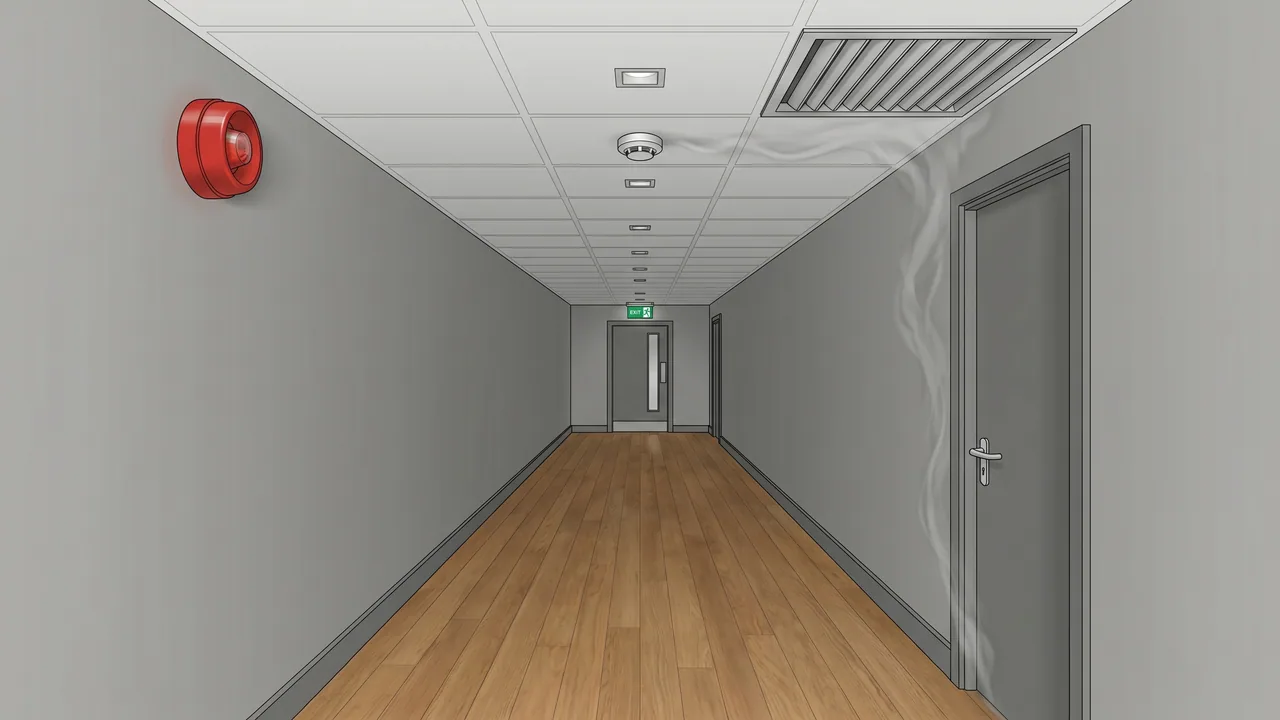
        Stage 1: Faint smoke smell — a thin wisp drifts at the ceiling from a distant doorway; one international safety-sign guidance exit sign at the far end, otherwise full visibility Stage 2: Light haze forms along the upper corridor ceiling, ceiling lights dim to a diffused glow, lower corridor still clear Stage 3: Dense untenable smoke fills the upper two-thirds of the corridor, visibility reduced to ~2m, an orange glow from the source doorway Stage 4 (Flashover): Flames erupt at the source doorway, thick black smoke billows along the ceiling, corridor fully unusable

        This corridor transitions from safe to untenable to flashover. Air and corridor conditions remain safe enough to see, breathe, and move. This is the period occupants have available to escape before conditions become unsafe. At flashover, the room flashes from a localised fire to full involvement and the corridor is lost. Building design — layout, lining, doors, ventilation — decides how long stages 1 to 3 last.

        Slide Source: 16

        What ASET Includes

        What is ASET mostly about?

        ASET considers:

        Slide Source: 17

        What RSET Means — How Long Do People Need?

        RSET = how long it takes everyone to leave safely once there is a problem.

        Default: Quiet classroom before alarm Stage 1: Alarm sounds in classroom Stage 2: Heads turn up Stage 3: Occupants stand up Stage 4: Occupants line up Stage 5: Occupants walk to exit Stage 6: Occupants exit and congregate at safe point

        RSET is the total time across all six stages. Anything that slows any stage -- delayed alarm response, unfamiliar route, crowded corridors -- increases RSET.

        Slide Source: 18

        What RSET Includes — Build the Timeline

        Drag each phase of evacuation onto the correct position in the timeline.

        RSET four-stage timeline: detection, alarm, pre-movement, travel
        Slide Source: 19

        Rule of Thumb — ASET Greater Than RSET

        The goal is for Available Safe Egress Time to exceed Required Safe Egress Time.

        ASET
        Longer
        RSET
        Shorter
        SAFE -- ASET > RSET. Everyone has enough time.
        Safe Unsafe

        In the unsafe scenario, RSET exceeds ASET -- people are still in the building when conditions become untenable. Every fire safety measure either increases ASET (building stays safe longer) or decreases RSET (people get out faster).

        Slide Source: 20

        ASET vs RSET — Summary

        ASET

        Available Safe Egress Time

        The safe time you have. Determined by how the building controls fire and smoke.

        >

        RSET

        Required Safe Egress Time

        The time you need. Determined by awareness, movement, travel, and exit.

        The golden rule: Fire safety succeeds when ASET exceeds RSET—when safe time is greater than needed time.
        Slide Source: 21

        What Parts of a Building Affect ASET?

        Click each highlighted zone on the burning building to discover how it affects ASET. Explore all zones to continue.

        Building cross-section showing fire in room of origin with 7 labeled safety zones
        Zones discovered
        Fire triangle connection — ASET is driven by fire and smoke development combined with how the building controls it — especially along escape routes.
        Slide Source: 22

        What Parts Affect RSET?

        The building itself determines how quickly occupants can get out. Click each highlighted zone on the floor plan to discover how it affects Required Safe Egress Time. Explore all 7 zones to continue.

        Floor plan cutaway with 7 numbered zones showing building features that affect RSET
        0 of 7 zones explored
        Fire triangle connection — RSET is about human response time, not fire control. Reducing RSET limits exposure — the less time people spend inside, the lower the risk of harm regardless of how the fire behaves.
        Slide Source: 23

        Applying ASET/RSET to Real Buildings

        ASET and RSET apply in every building type, but the balance between them looks different in a home, an office, and a hospital. Each card below shows what extends ASET (time before conditions turn untenable) and what extends RSET (time required to get everyone out) — then links to the deeper scenario.

        Every card shows a compliant UK cutaway. Pick one to explore its ASET and RSET scenarios in detail — the balance between the two blue and orange bars is what fire-safety design exists to protect.
        Slide Source: 24

        Scenario 1: Home ASET

        In a dwelling, internal door position has a dramatic effect on how quickly smoke spreads. Toggle between the two states to see how door position changes Available Safe Egress Time.

        Home interior cutaway with internal doors open and smoke spreading rapidly through hallway
        Doors Open

        With internal doors open, smoke from a room of origin spreads rapidly throughout the dwelling. Hall and stairway become untenable quickly. ASET shortens — occupants need to be alert and mobile to escape safely.

        Fire triangle connection — Closed doors limit oxygen supply to the fire and block the smoke pathway. Both effects extend ASET, giving occupants time to escape.
        Slide Source: 25

        Scenario 1: Home RSET

        Five building features directly affect how quickly a household can evacuate. Click each hotspot on the home plan to explore what role each feature plays.

        Two-storey UK dwelling architectural cutaway: ceiling smoke detector on upstairs landing, bedroom doorway with partial interior glimpse, centre oak staircase with aluminium handrail, ground-floor casement escape window with lever handle, warm oak six-panel front exit door with letterbox, lever handle, thumb-turn deadlock, and knocker. No burned-in numerals or labels.
        0 of 5 features checked
        Slide Source: 26

        Scenario 2: Office ASET

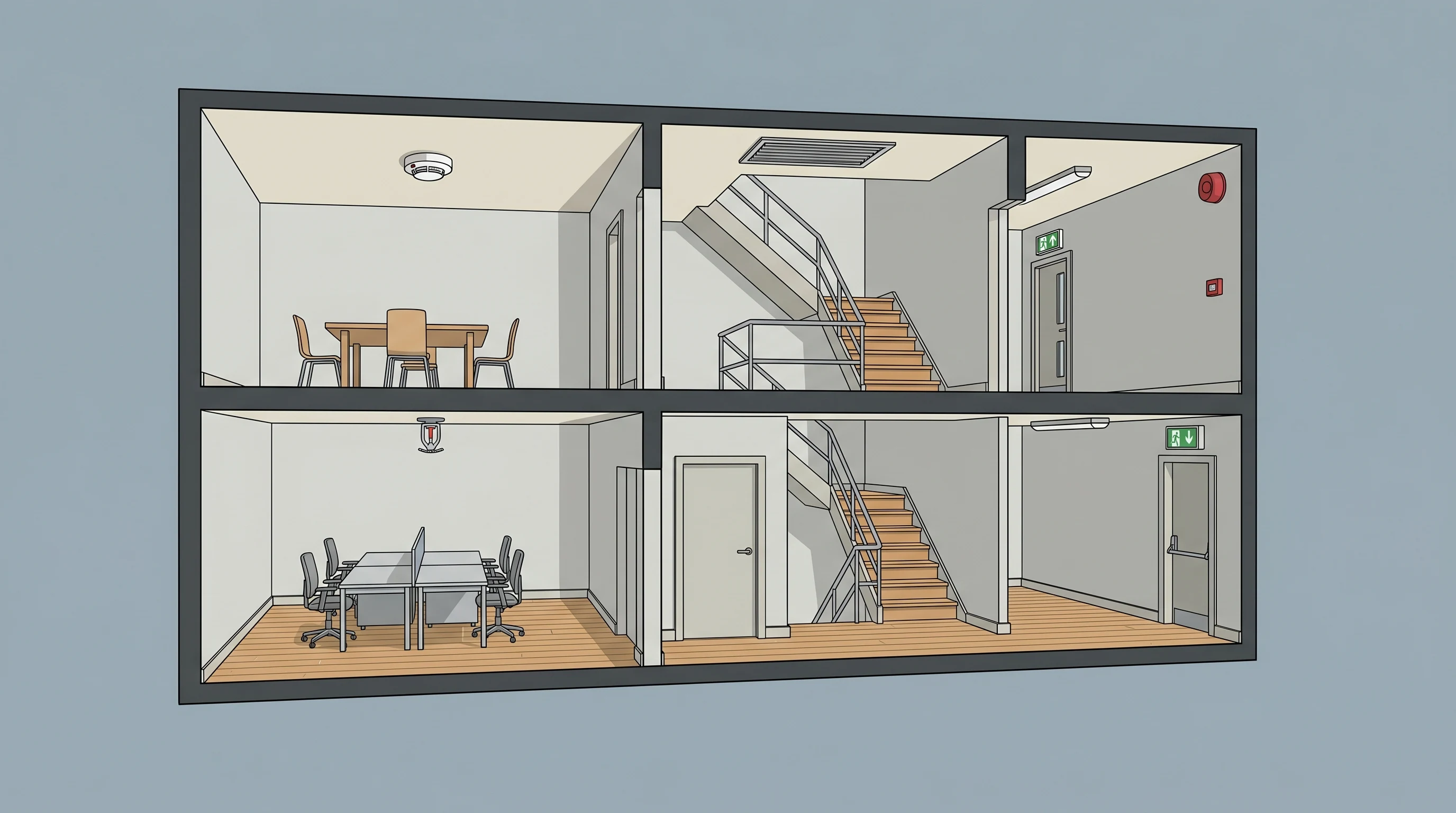
        An office building uses multiple protective layers to extend ASET across all floors. Toggle each layer on to see how it contributes to keeping escape routes tenable.

        Architectural cross-section of a four-storey UK office: open-plan office at left, protected lobby and stair core at right, concrete floor slabs, FD30 fire doors, ceiling sprinkler pipework

        Enable layers to see their effect.

        Every layer adds margin to ASET. Removing even one — a wedged lobby door, a missing sprinkler zone — can be the difference between a safe evacuation and a fatality.
        Slide Source: 27

        Scenario 2: Office RSET

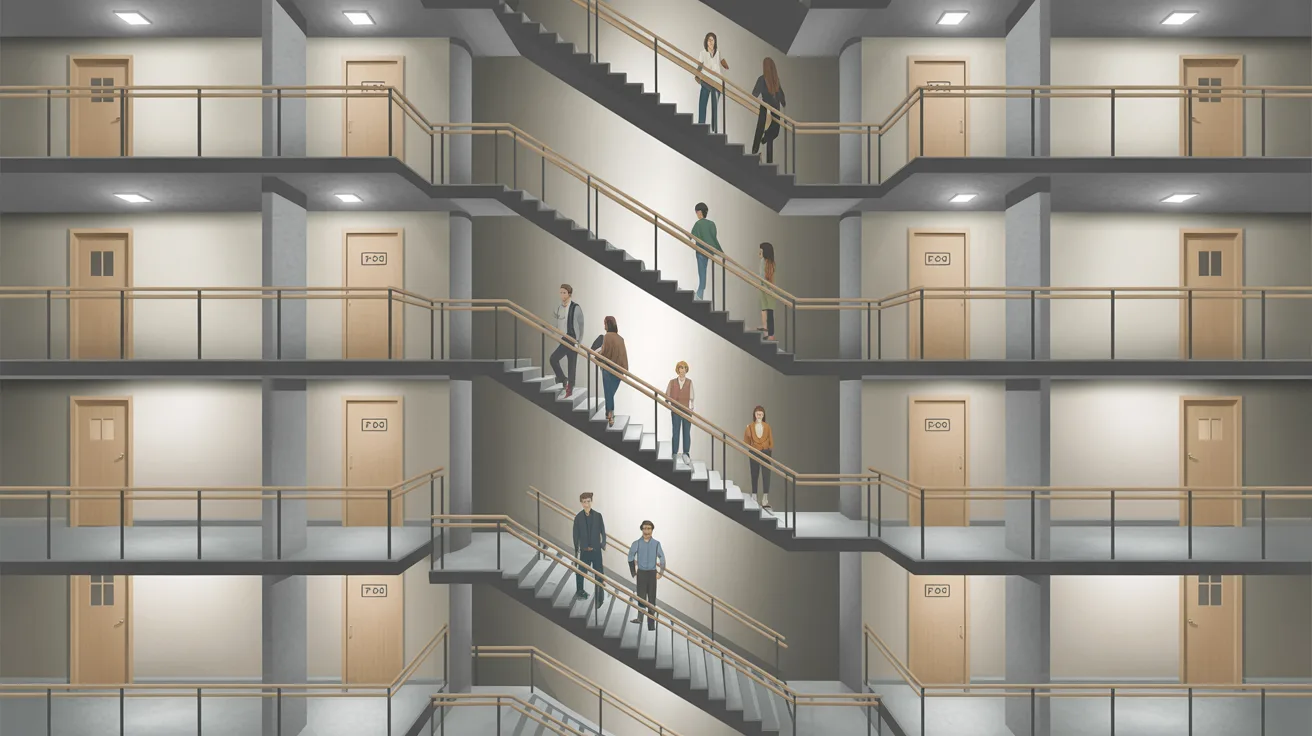
        A five-storey office with one protected stair. Pick a scenario to see how stair capacity and occupant load change the total Required Safe Egress Time (RSET).

        Cross-section of a five-storey office stairwell with a small number of workers descending freely, good spacing between individuals and no queuing
        Light load · RSET flows freely

        A small number of occupants leave each floor together. The stair flows freely, so RSET is dominated by pre-movement and walking time rather than queuing.

        Principle — RSET is a function of human flow rate, not fire behaviour. Lowering occupant density or widening the stair cuts RSET independently of fire control (fire-safety engineering principles).
        Slide Source: 28

        Scenario 3: Hospital ASET

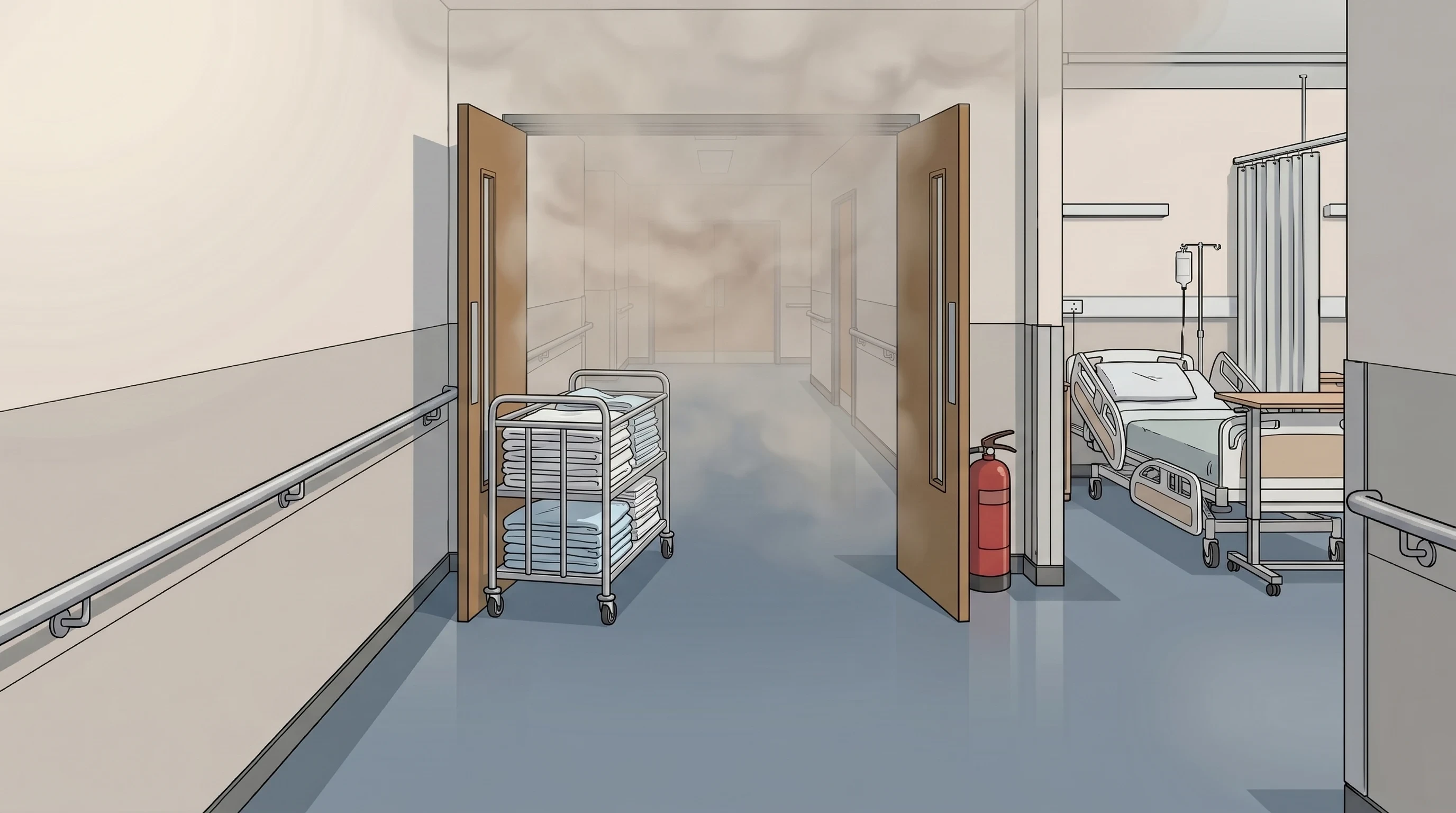
        In a hospital ward, cross-corridor fire doors are the primary line of defence against smoke spread. Toggle the door state to see how compartmentation changes the picture for non-ambulant patients.

        Hospital ward plan with cross-corridor fire doors open and smoke spreading across bays
        Doors Open

        When cross-corridor fire doors are held open, smoke from a single-room fire spreads rapidly across the entire ward. All patients in the corridor and adjacent bays face risk at the same time.

        Fire triangle connection — Closed doors limit oxygen supply and block the smoke pathway, extending the time available for evacuation and supporting progressive horizontal movement of patients.
        Slide Source: 29

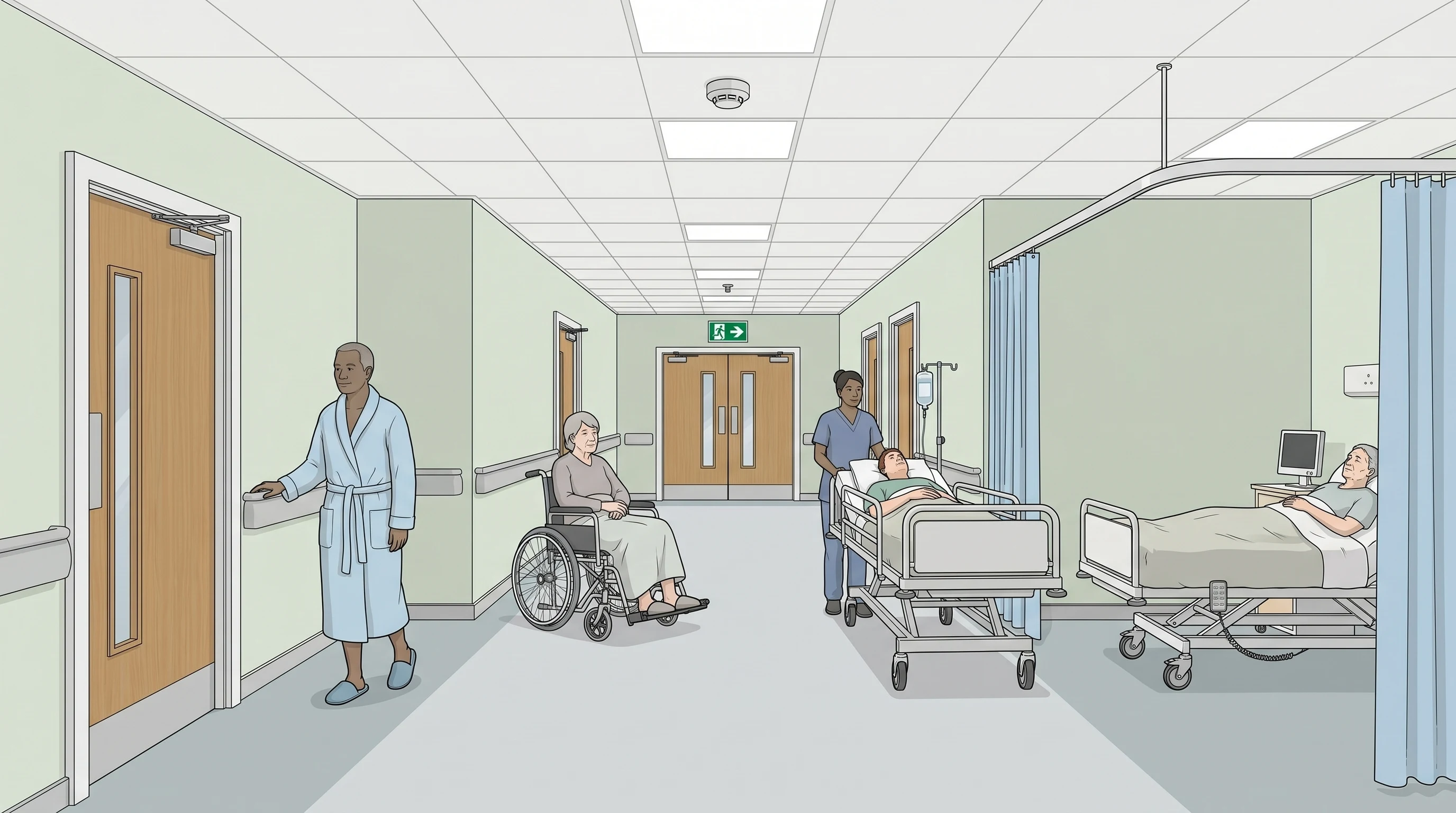
        Scenario 3: Hospital RSET

        Not every patient can evacuate the same way. Drag each blue strategy onto the patient it fits. Match all four to see why hospital RSET is higher than a typical office.

        Hospital corridor with four patient mobility archetypes: ambulant, wheelchair, trolley, bed-bound
        Drag a strategy onto a patient
        0 of 4 matched
        Slide Source: 30

        ASET vs RSET: The Safety Margin

        Move the sliders to simulate the effect of building and occupancy changes. The safety margin is the gap between the two bars. Green means safe; red means at risk.

        ASET

        ASET > RSET — Safe

        RSET
        To increase safety: extend ASET (passive/active measures) and reduce RSET (better detection, wider stairs, clearer signage). Both levers matter.
        Slide Source: 31

        Passive vs Active Fire Safety

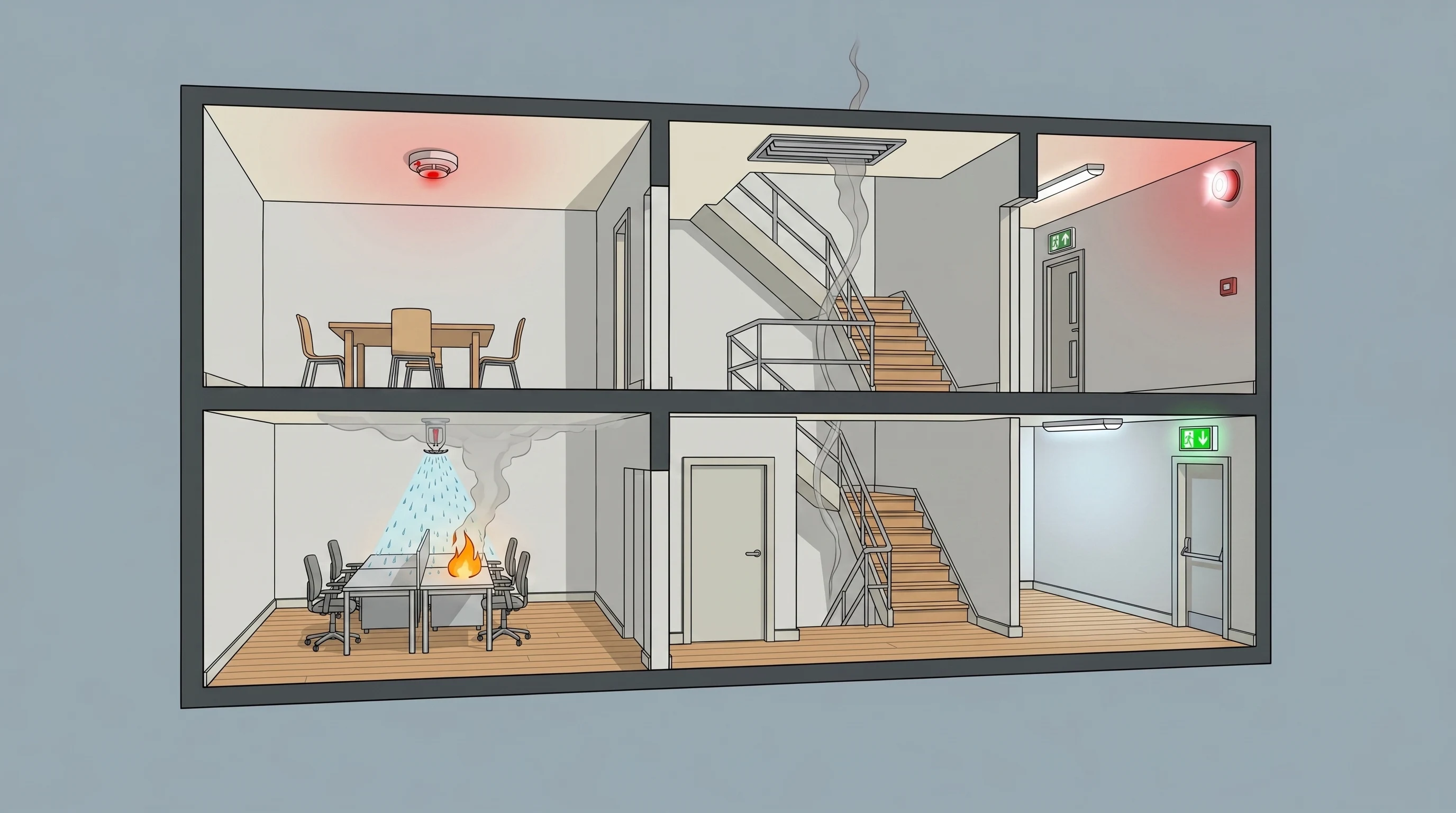
        A building has two families of defences. Passive measures are built into the fabric and work without power or triggers. Active measures wake up when a fire starts — they detect, warn, and suppress. Flip the switch to see the same corridor in both states. Tap a numbered marker to learn what each part does.

        Commercial corridor in the passive state: fire door closed with intumescent seal, compartment wall, fire-stopping collar on a service pipe; detector, sounder and exit light visible but inactive. No sprinklers - circulation areas are not normally sprinklered.
        Passive (always-on)
        Pick a marker
        Tap any numbered dot on the scene to see what that feature does in this state.

        Passive measures are always present. Walls, floors, fire doors and cavity barriers work without power or activation. They contain the fire and keep escape routes usable.

        AttributePassiveActive
        Always on?YesNo — activates on a trigger
        Needs power?NoUsually yes
        Needs a trigger?NoHeat, smoke or manual call
        Main jobContain fire; protect escape routesDetect, warn, suppress
        Fails quietly if…Doors wedged, seals damaged, fire-stopping missingNo power, blocked heads, untested, expired
        They work together. Passive measures extend the time occupants have to escape. Active measures cut the time it takes them to realise, react, and move. Remove either side and the safety margin shrinks fast.
        Slide Source: 32

        What Each Element Achieves

        Both passive and active systems ultimately deliver the same outcome: time and usable escape routes. Drag each outcome statement into the correct column.

        Passive Outcomes
        Active Outcomes
        0 of 8 placed
        Slide Source: 33

        Passive = Built-in Protection

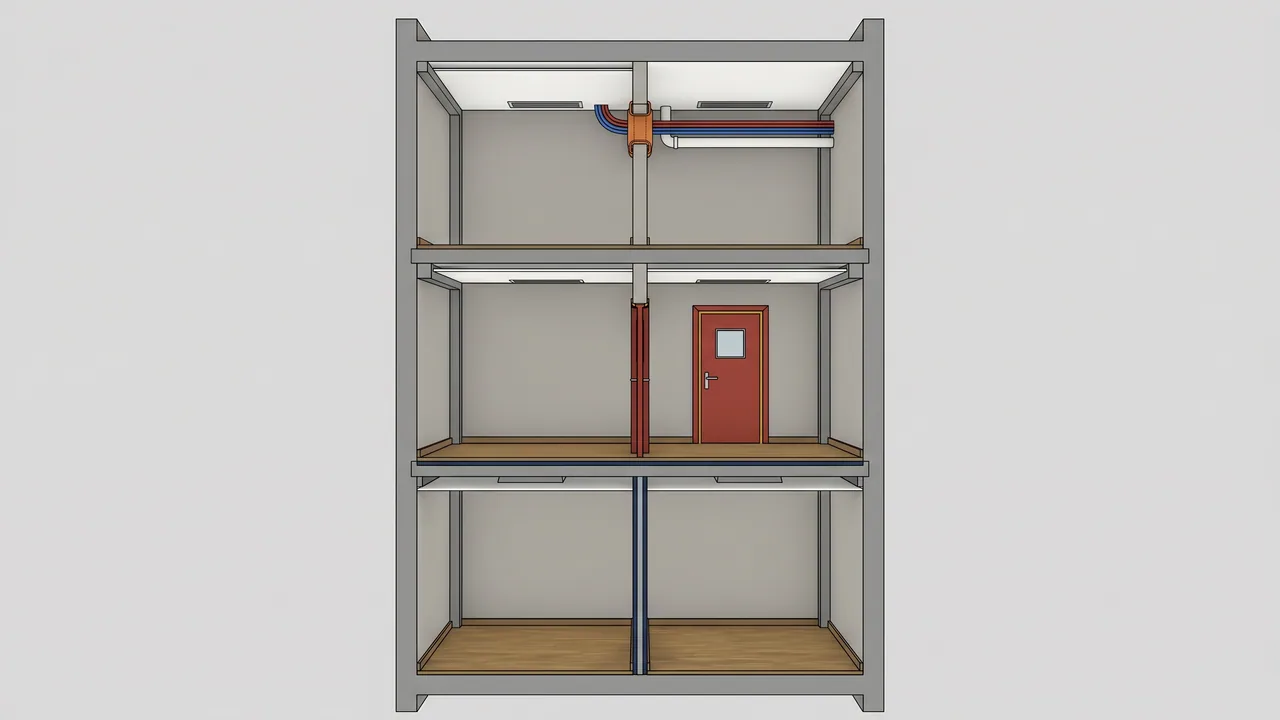
        Think of every room as a box that is designed to contain fire and smoke long enough for people to evacuate safely. Four parts of the building work together to keep the box sealed. Tap each highlighted area on the cutaway to see a close-up of that part, what it does, and what happens when it fails. Then flip Protected ↔ Breached to track the chain.

        Three-storey building cutaway: compartment walls and floors, a red fire door on the middle floor, an orange fire-stopping collar around services penetrating the top slab, and a vertical service riser enclosed by cavity barriers.
        ← Tap a highlighted area on the cutaway
        Each one is a passive pillar that keeps the compartment sealed.
        Compartment chain
        Holding

        Common operating principles

        Tap a principle to see how it works on the building.

        Spot the Weak Link

        One pillar on this compartment has been breached. Which one is letting smoke through?

        Slide Source: 34

        Compartmentation: The Lunchbox Analogy

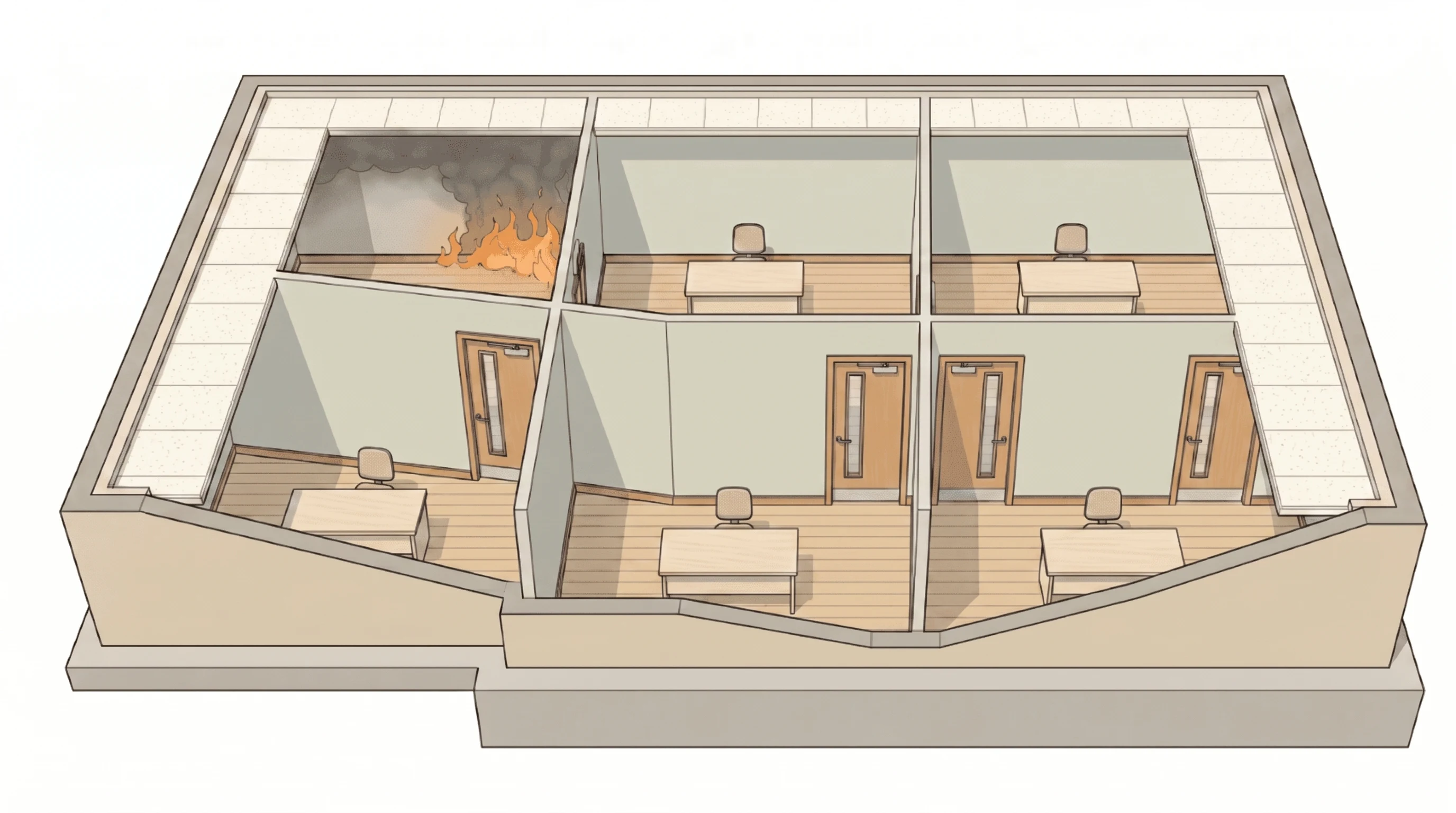
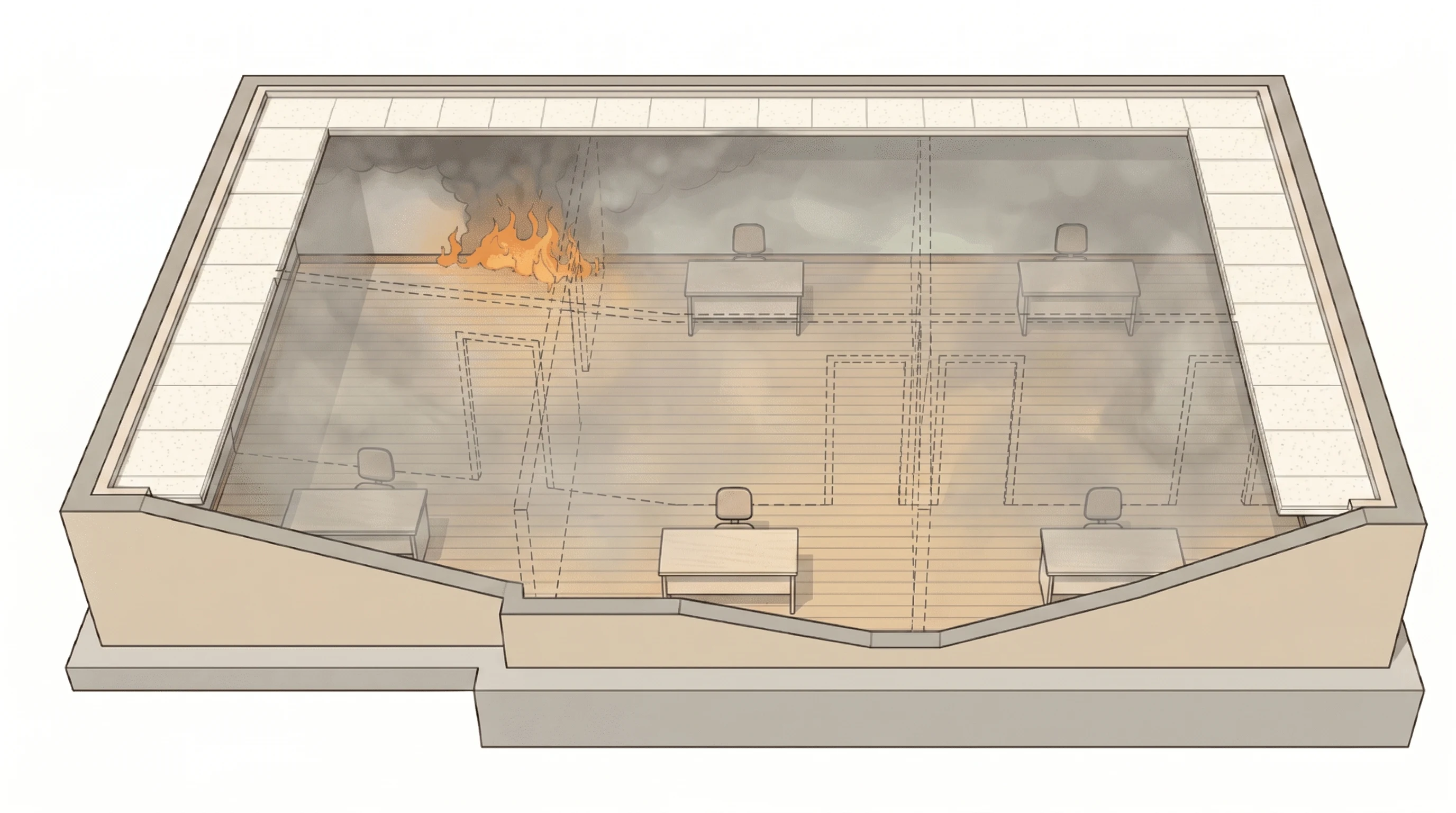
        Compartment walls are dividers inside a building - the same way a lunchbox has dividers between sections. Drop in a spill and only one section gets contaminated. Remove the dividers and it spreads everywhere.

        Walls ON
        Isometric cutaway of an office floor with fire-resisting compartment walls. Fire and smoke are contained in one bay; the other bays remain clear.
        Fire is sealed into the bay where it started. The other bays stay clear, so occupants can leave at walking pace.
        Walls OFF
        Same office floor with the interior compartment walls removed. Smoke has filled the whole open floor-plate from a single ignition.
        With no dividers, smoke spreads rapidly throughout the floor. Every occupant loses tenable air.
        Slide Source: 35

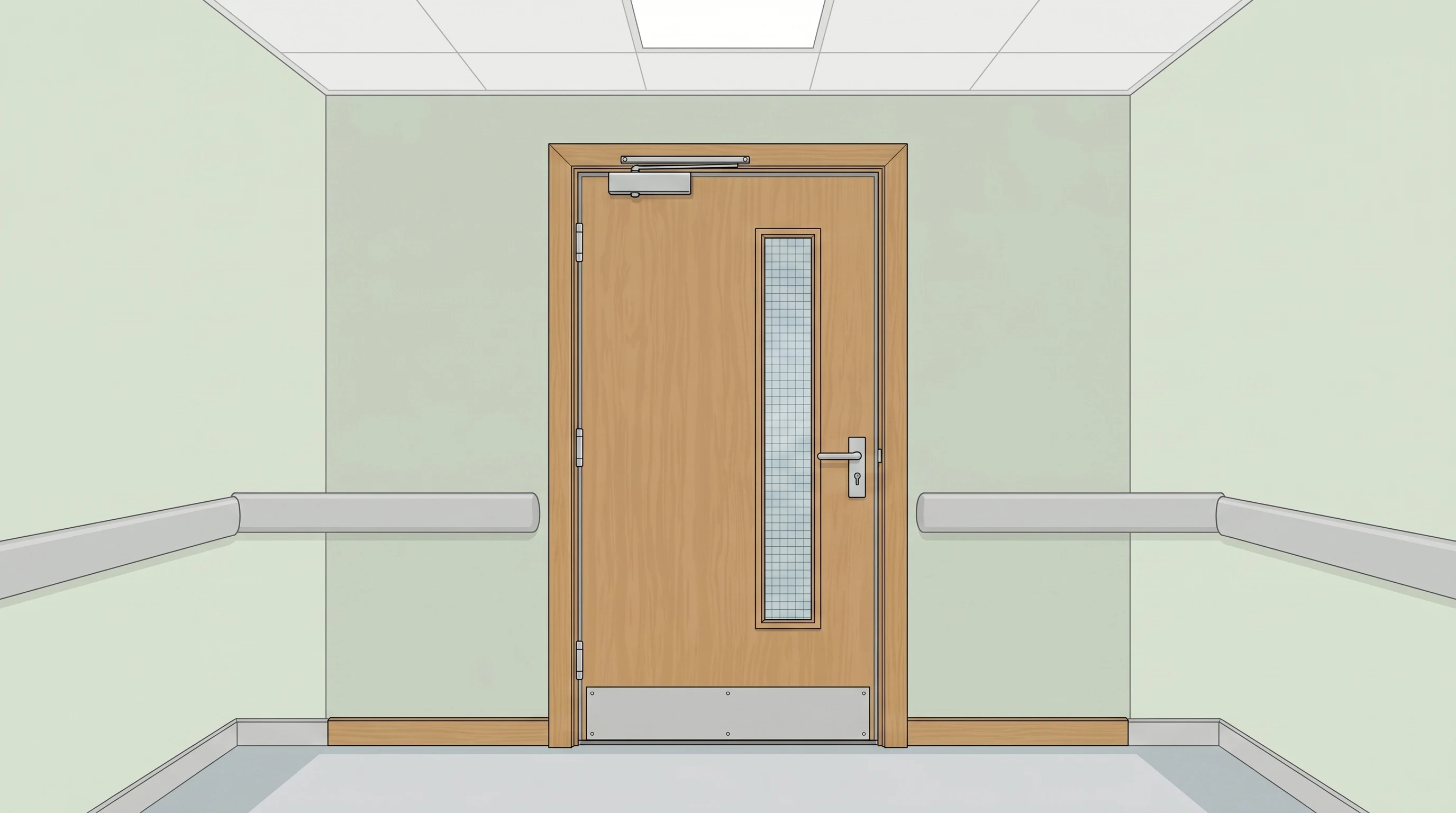
        Fire Doors

        A fire door is an assembly of six working parts. If any one of them fails, the whole door fails. Tap each glowing spot on the door below to see what the part does, what goes wrong, and how it gets fixed.

        Warm-oak timber fire door with tall glazed vision panel in a quiet hospital corridor. Six glowing markers sit on the door leaf for the learner to tap: vision panel, overhead closer, hinges, edge seals, lever and latch, threshold and floor gap.
        ← Tap a glowing spot on the door
        Each one explains a different part of the fire door.
        0 of 6 parts inspected
        Slide Source: 36

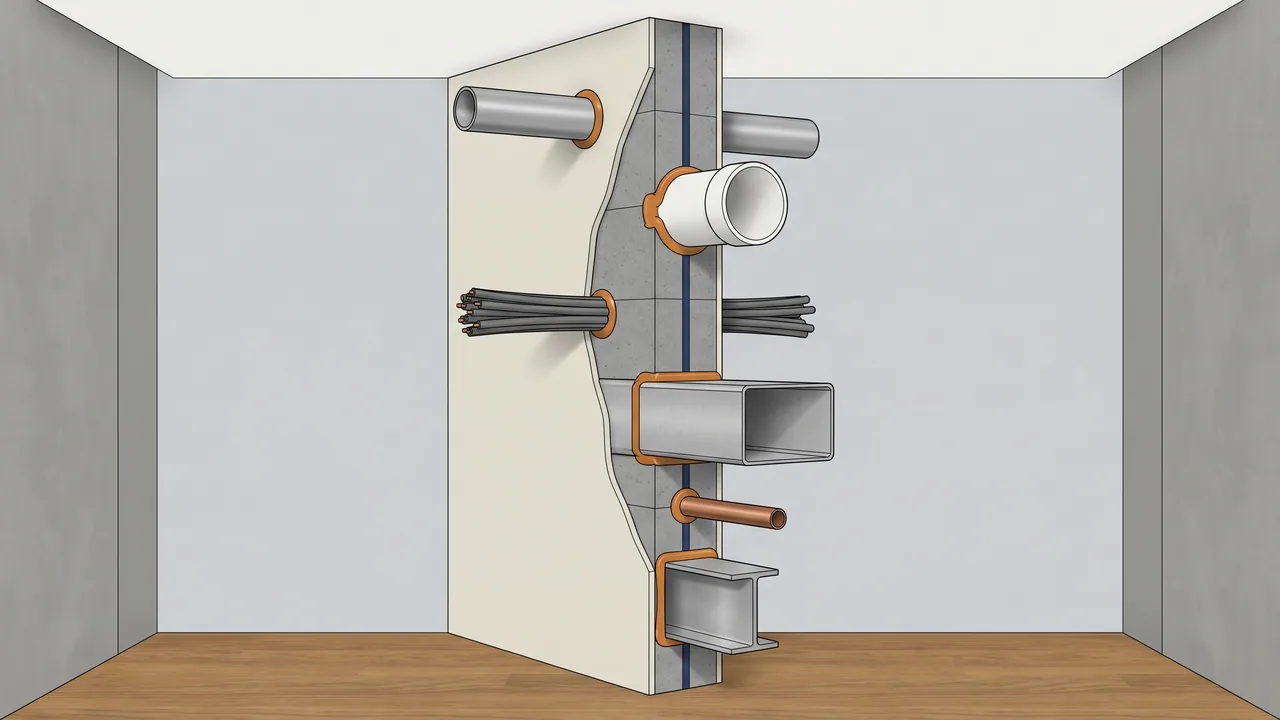
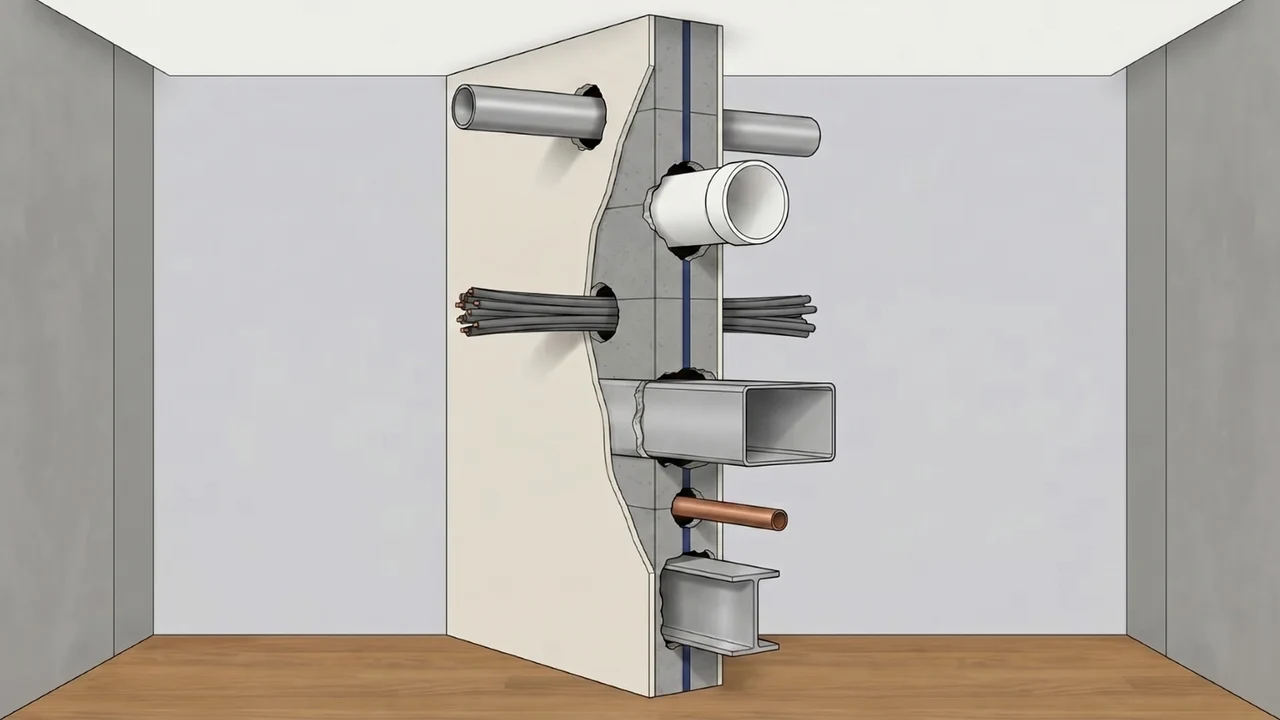
        Seal the Gaps in the Fire Wall

        A fire wall only works if every service that crosses it is sealed. Click each open penetration to seal it and learn why it matters.

        Wall section cutaway with six unsealed service penetrations through a fire wall
        Pick a penetration. Each one is a potential route for smoke and flame. Click any marker on the wall to see the risk and the correct seal.
        0 of 6 sealed
        The goal of a fire-stopping system is to match the fire resistance of the wall it crosses. Designers look for compatible products from the same tested system.
        Slide Source: 37

        Active = Built-in Warning and Suppression

        Active systems don't fire all at once. Press Start and watch them respond in sequence — each one buys the building a little more time.

        Ready Press Start or tap any number on the right to read what each system does
        Slide Source: 38

        Detection and Alert

        Detection starts the process. Watch the sequence play out — each stage extends your margin for safe evacuation.

        Ceiling-mounted detector with a thin smoke collar curling around it in a corridor
        Stage 1

        Smoke reaches the sensor

        Smoke curls up into the ceiling-mounted multi-sensor detector. Its status light switches red and the control panel starts verifying the signal.

        The building has noticed — no one has heard anything yet.

        Stage 1
        Slide Source: 39

        Suppression: Sprinklers in Action

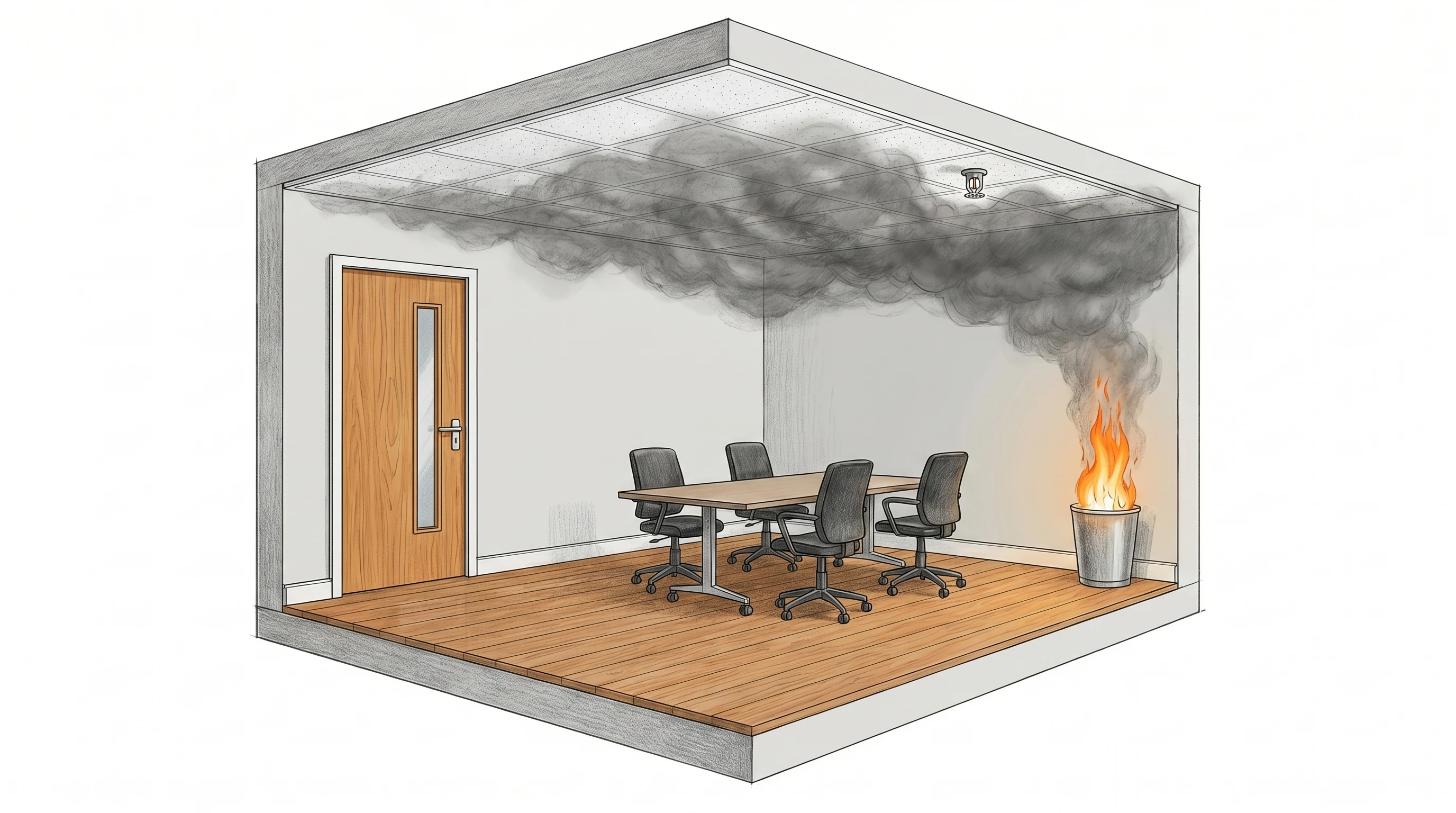
        A single sprinkler head can change the outcome of a fire completely. Toggle between the two states to compare fire development with and without suppression.

        Room with uncontrolled fire growing rapidly and thick smoke filling the ceiling layer
        No Sprinkler

        Without suppression, the fire grows rapidly. The ceiling smoke layer descends, temperatures rise to unsafe levels, and flashover becomes a risk for the entire room.

        Fire triangle connection — Sprinklers work on two sides of the fire triangle: they reduce heat through cooling and displace oxygen from the fire zone through steam.
        Slide Source: 40

        Smoke Control and Emergency Lighting

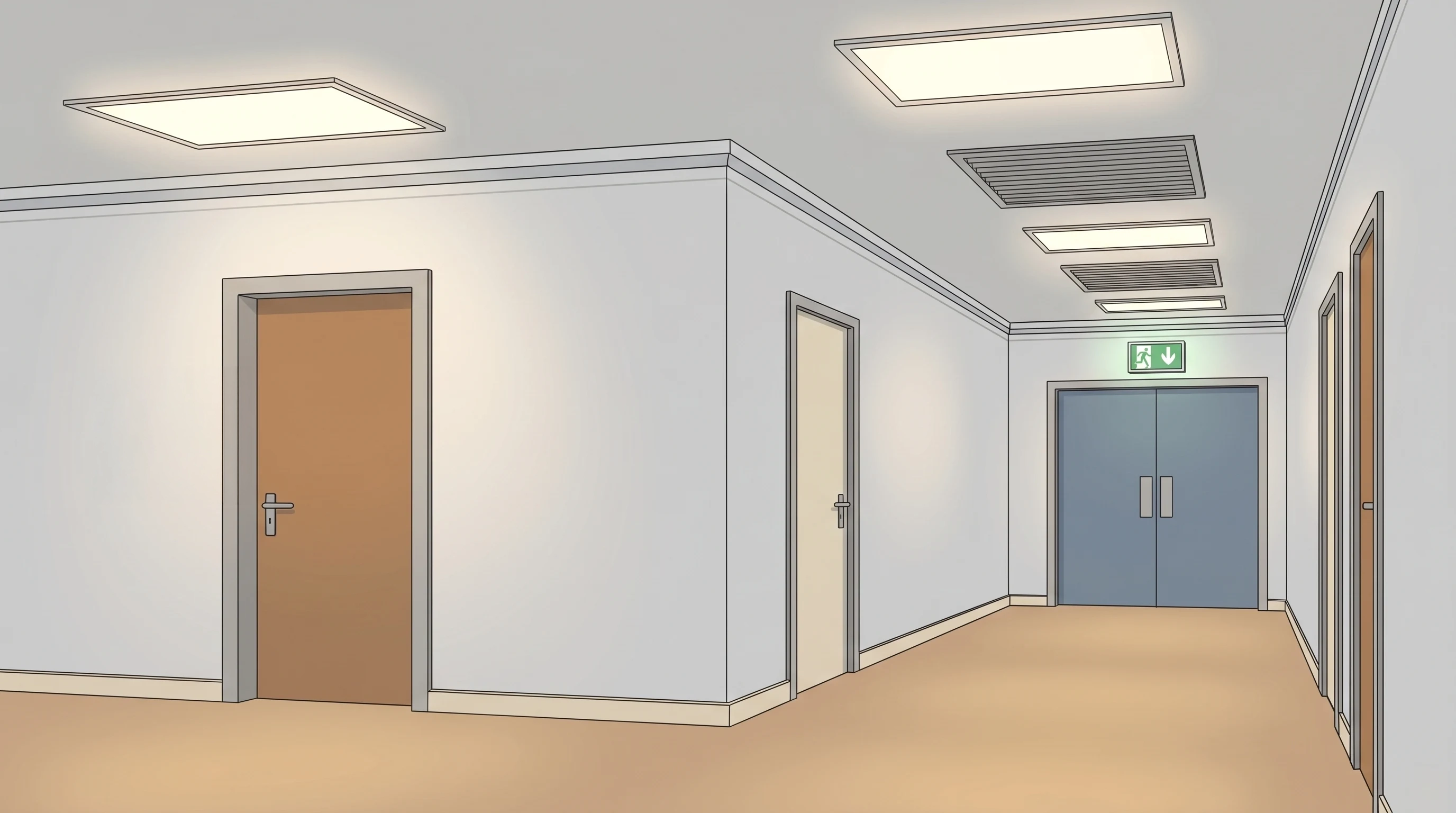
        Mains power and smoke control work together during normal operation. When both fail at the same time — as they can in a fire — dedicated emergency systems activate to maintain safety. Toggle the two states.

        Well-lit corridor with normal overhead lighting and clear visibility to exit signs
        Normal Power

        During normal operation, overhead lighting and standard exit signs illuminate the corridor. Smoke control ventilation is on standby.

        Slide Source: 41

        Passive and Active: Working Together

        Neither passive nor active fire safety is sufficient alone. Together, they create the safety margin between ASET and RSET. Click each node in the diagram to explore its role.

        Passive Systems Walls, floors, doors, fire stopping Buy Time Active Systems Detection, alarms, sprinklers, lighting Warn + Respond ASET > RSET Life Safety Explore Passive Explore Active
        Slide Source: 42

        Passive/Active Knowledge Check

        Four questions to check your understanding of passive and active fire safety. Answer each question to unlock the next.

        Question 1 of 4
        Slide Source: 43

        External Fire Spread

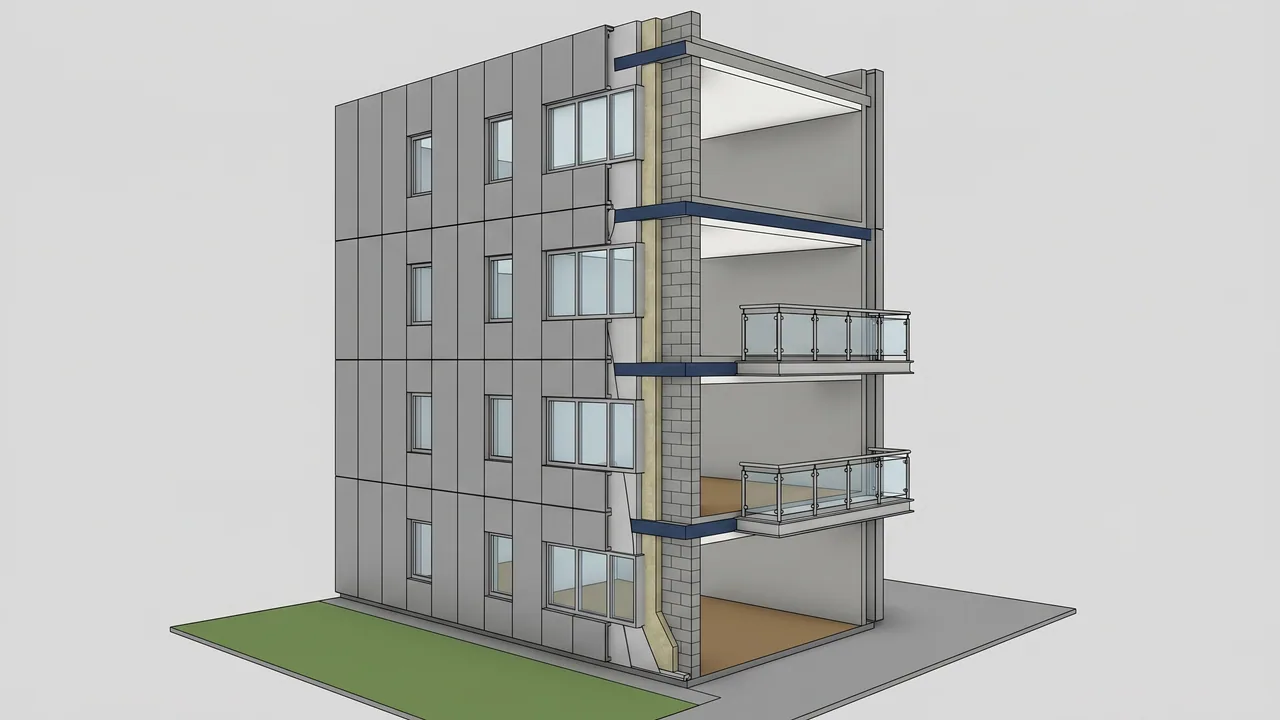
        Fire can travel up the outside of a building just as it spreads internally. Three facade features determine the rate of external vertical spread. Click each to learn more.

        Multi-storey building facade section showing external wall cladding, cavity, and balcony detail
        Explore facade features to understand fire risks
        Fire triangle connection — External spread involves all three sides: fuel (cladding/insulation), heat (fire ejected from a window), and oxygen (unobstructed airflow up the facade).
        Slide Source: 44

        Triangle + Time + Features = Safety

        Every fire safety feature belongs to multiple categories. Drag a card to a column — or click a card then click its destination. Features may serve multiple purposes; pick the one that best captures its primary role.

        Drag a card, or tap to select.
        0 of 15 placed
        Slide Source: 45

        The Importance of Workmanship

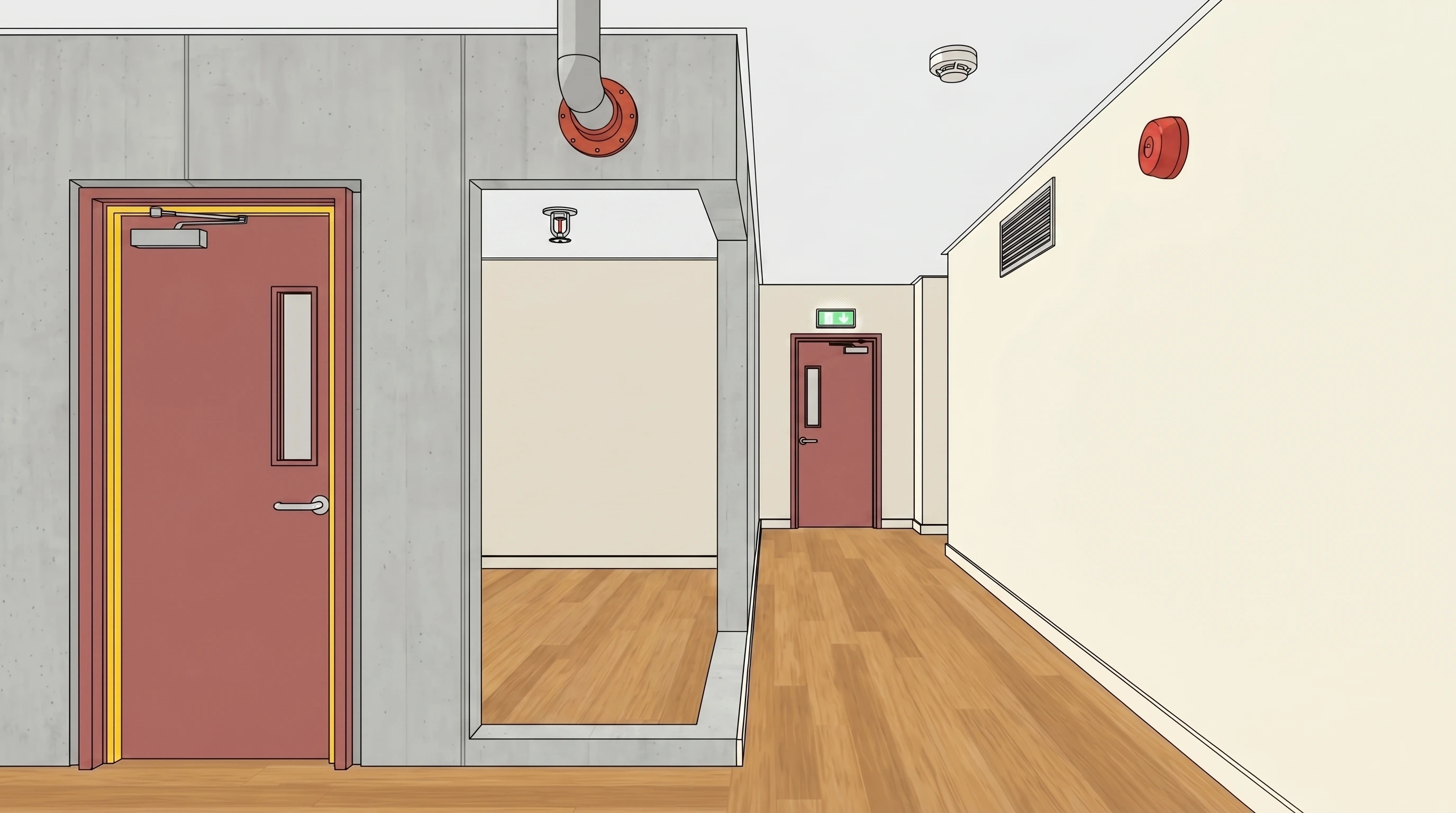
        A building can be designed perfectly and still fail at the point of installation. Find all four defects in this scene. Click each one to reveal what is wrong and how to fix it.

        Corridor scene showing four workmanship defects: door frame gap, missing closer, unsealed cable penetration, and wrong-rated intumescent
        0 of 4 defects found
        Workmanship principle — The protective performance of fire-safety systems depends on installing all components according to their design specifications. When materials are substituted, components are damaged, or installation deviates from the approved design, the assembly's fire-protection capability is compromised.
        Slide Source: Final

        Final Assessment

        Course-wide knowledge check covering Modules 0 through 6. Mixed-type questions evaluate your understanding. Demonstrate solid comprehension to pass.

        Before you start

        Final assessment — Each question links back to the module it came from. Retake as often as you like.

        Glossary

        45 fire-safety terms. Linked from trainer notes where relevant.

        45 of 45
        Active Fire Protection — Systems and equipment that actively detect, suppress, or control fire through mechanical or electrical means, such as sprinklers, alarms, and fire extinguishers, requiring activation or operation to function.
        Alarm System — An integrated set of devices and controls that detect fire, smoke, or heat and automatically alert occupants and emergency services through audible and visual signals. Alarm systems are essential life-safety equipment required in most buildings to enable rapid evacuation and emergency response.
        ASET — Available Safe Egress Time: the duration occupants have to evacuate a building before conditions become untenable, determined by analyzing smoke spread, temperature rise, and visibility loss during a fire.
        Cavity Barrier — A fire-resistant material or construction installed within concealed spaces (such as wall or ceiling cavities) to prevent fire and smoke from spreading through the void. Cavity barriers subdivide large cavities into smaller sections to slow fire propagation and maintain compartmentalization.
        Class A Fire — A fire involving ordinary combustible materials such as wood, paper, cloth, and plastics. Class A fires require cooling and water-based extinguishing agents to suppress the flames and prevent reignition.
        Class B Fire — A fire involving flammable liquids or gases, such as petrol, oil, or propane. Class B fires require suppression methods that do not allow the fuel to spread, typically using foam, dry powder, or carbon dioxide.
        Class C Fire — A fire involving energized electrical equipment or wiring where the electrical current itself presents a hazard. Extinguishing agents must be non-conductive to prevent electrocution risk.
        Class D Fire — A fire involving combustible metals such as magnesium, titanium, or sodium. These fires require specialized extinguishing agents and cannot be safely extinguished with water or standard fire suppressants.
        Class F Fire — A fire involving cooking oils and fats at high temperatures. Class F fires require specialized extinguishing agents, typically wet chemical suppressants, to cool the fuel and prevent reignition without violent reaction.
        Compartment Wall — A fire-rated barrier wall that divides a building into separate fire compartments to contain fire and smoke, preventing spread to adjacent areas and allowing occupants time to evacuate safely.
        Compartmentation — The division of a building into separate fire-resistant sections using walls, doors, and floors to contain fire and smoke, limiting spread and protecting escape routes and adjacent spaces.
        Detection System — An integrated network of sensors and devices that automatically identifies fire, smoke, or heat and alerts occupants and emergency services. Detection systems enable early warning and rapid response to minimize life safety and property risks.
        Dry Riser — A vertical pipe system installed in buildings to supply water for firefighting, kept empty during normal operation and filled by fire service pumps during emergencies. Allows rapid water delivery to upper floors without relying on building water pressure.
        Duty Holder — A person or organization legally responsible for ensuring fire safety compliance within a building or premises. This includes maintaining safety systems, conducting risk assessments, and implementing preventive measures to protect occupants.
        Evacuation Plan — A documented procedure identifying escape routes, assembly points, and responsibilities for safely removing all occupants from a building during an emergency. It establishes clear pathways, communication methods, and accountability measures to minimize risk and ensure orderly departure.
        Fire Door — A door assembly designed to resist fire spread and maintain structural integrity during a fire, typically rated for a specified duration and equipped with self-closing mechanisms and fire-resistant materials to protect escape routes and compartmentalize buildings.
        Fire Load — The total amount of combustible material present in a space, measured by the heat energy it would release if completely burned. Fire load determines how long and intensely a fire might burn in that area.
        Fire Stopping — The sealing of openings and gaps in fire-rated walls, floors, and doors to prevent fire and smoke from spreading between compartments. Fire stopping materials and systems maintain the integrity of fire barriers during a fire event.
        Fire Strategy — A comprehensive plan that outlines how a building or organization will prevent fires, detect them quickly, protect occupants, and manage evacuation and emergency response to minimize harm and property loss.
        Fire Triangle — The three essential elements required for fire: heat, fuel, and oxygen. Removing any one element extinguishes the fire, forming the basis of fire prevention and suppression strategies.
        Flashover — A rapid transition to full fire development in which all combustible materials in an enclosed space ignite nearly simultaneously, causing temperatures to rise sharply and flames to spread across the entire compartment.
        Heat Release Rate — The rate at which a material or product releases thermal energy when burning, measured in kilowatts (kW). Used to classify fire hazard and predict flame spread behavior during early fire development.
        Hose Reel — A fixed or portable device that stores and dispenses fire hose, typically mounted on walls or stands for quick access during fire emergencies. Hose reels enable rapid deployment of water to suppress fires in buildings and industrial facilities.
        Intumescent Seal — A fire-resistant material that expands when exposed to heat, sealing gaps around doors, windows, or penetrations to prevent smoke and flame spread. Commonly used in fire-rated assemblies to maintain compartmentalization during a fire.
        Means of Escape — A continuous, unobstructed route enabling occupants to evacuate a building safely to a place of safety during an emergency. It includes exits, corridors, stairs, and doors designed to facilitate rapid, orderly egress.
        Passive Fire Protection — Building materials and construction methods that contain fire and smoke without active intervention, such as fire-rated walls, doors, and structural protection systems designed to maintain integrity during exposure to heat.
        Portable Extinguisher — A handheld fire-suppression device designed to be carried and operated by one person to extinguish small fires at their point of origin. Typically classified by agent type (water, foam, powder, or gas) and marked with appropriate hazard symbols for safe selection and use.
        Pressurisation System — A mechanical system that maintains higher air pressure inside a protected space (such as a stairwell or escape route) than in surrounding areas, preventing smoke infiltration during a fire. Typically uses fans and dampers to keep escape routes safe and tenable.
        Protected Escape Route — A passageway designed and maintained to enable safe evacuation from a building, featuring fire-resistant construction and safeguards such as enclosed walls, automatic doors, and emergency lighting to protect occupants from smoke and flames.
        Pyrolysis — The chemical decomposition of a material caused by heat in the absence of oxygen, producing flammable gases and char. This process precedes ignition and is fundamental to fire development.
        Reaction to Fire — The tendency of a material to ignite, flame, or contribute fuel when exposed to heat or fire. Measured through standardized tests to classify materials by their flammability and smoke-production characteristics.
        Resistance to Fire — The ability of a building element or material to withstand exposure to fire and maintain its structural integrity and protective function for a specified duration, measured by criteria including integrity, insulation, and load-bearing capacity.
        Responsible Person — An individual designated to ensure fire safety compliance within a building or organization, including hazard identification, emergency procedures, and regulatory adherence.
        Risk Assessment — A systematic evaluation of fire hazards, vulnerabilities, and potential consequences within a building or facility to identify risks and determine appropriate control measures and safety priorities.
        RSET — Required Safe Egress Time: the maximum duration occupants need to evacuate a building safely from initial alarm to reaching a place of safety, accounting for detection delay, notification, and movement time.
        Self-Closing Device — A mechanical or automatic mechanism that closes a door or opening without manual intervention after it has been opened. Commonly used on fire doors to maintain compartmentation and prevent smoke and flame spread.
        Simultaneous Evacuation — An evacuation strategy where all occupants leave a building at the same time, typically used in low-rise buildings where escape routes have sufficient capacity. This approach prioritizes speed over phased departure methods.
        Smoke Control — Systems and design measures that manage smoke movement during a fire to maintain safe evacuation routes and protect occupied spaces. Typically achieved through pressurization, exhaust, or compartmentation to delay smoke spread.
        Smoke Seal — A compressible material or device installed in gaps around doors, windows, or penetrations to restrict smoke passage during a fire. Smoke seals maintain compartmentalization by limiting smoke migration between fire-rated areas.
        Sprinkler System — An automatic fire suppression system that detects heat and distributes water through overhead pipes and nozzles to control or extinguish fires. Designed to activate independently without manual intervention, protecting occupants and property.
        Stay Put — A fire safety strategy instructing occupants to remain in their sealed rooms rather than evacuate, relying on compartmentation and refuge areas to provide protection until rescue or fire suppression occurs.
        Suppression System — An engineered arrangement of equipment and agents designed to automatically detect and extinguish or control fires, preventing their spread and protecting life and property. Common types include sprinkler systems, foam systems, and gaseous suppression systems.
        Wet Riser — A vertical pipe system permanently filled with pressurized water, installed in buildings to supply firefighting hoses at each floor level. Enables rapid water delivery for manual fire suppression without requiring firefighters to connect to external sources.